Where What if Design fits in We're a senior-led creative studio built specifically for climate tech, clean tech, and deep tech founders. Since 2020, we've partnered with teams like HYDGEN, Ribbit Network, and Susteon to turn hard-to-explain technology into brands, websites, and product experiences that raise capital and win adoption. This comparison reflects how we evaluate the trade-offs when a founder asks us which route to take.
Squarespace and Webflow are the two platforms nearly every founder considers when it's time to build a first website, and they solve the problem in very different ways. One prioritizes speed and simplicity. The other prioritizes control and scale.
For a hobbyist blog, that difference barely matters. For a startup, it changes everything: how fast you launch, how the site holds up as you raise funding and add features, and how much time and money you'll spend maintaining it later.
This guide breaks down what each platform actually is, how they stack up on the factors founders care about most, and a real-world look at how a climate tech company approached this exact decision.
TL;DR: key takeaways
- Squarespace ships faster: a clean, professional site live in days, no hiring required
- Webflow unlocks design control, SEO depth, and content scaling without a rebuild
- Pricing starts close, but Webflow's costs grow with your CMS and team
- Pick by fit: your team's skills and growth plans matter more than which tool is "better"
1. Squarespace vs Webflow: quick comparison for startups
Here’s how the two platforms compare on the four factors early-stage teams care about most.
1.1 Cost
- Squarespace bundles hosting, SSL, and templates into one flat fee, typically $16, $25/month by tier and billing cycle.
- Webflow starts at a similar entry price, then climbs with CMS items, traffic, and Workspace seats.
- Webflow seats: full seats (Admin, Site Manager, Designer) ~$39/month yearly; limited seats (Marketer, Content Editor) ~$15/month.
1.2 Design flexibility & customization
- Squarespace offers polished templates and a drag-and-drop Fluid Engine editor. Going far outside the template without custom code is hard.
- Webflow offers pixel-level control over layout, animation, and responsive behavior through a visual canvas that generates clean, semantic code underneath.
1.3 Ease of use for non-technical founders
- Squarespace's guided editor requires zero design or development background. Most founders can have a homepage live in an afternoon.
- Webflow's interface feels like pro design software, powerful, with a real learning curve if no one on the team has design experience.
- On G2, Squarespace scores 8.8 for ease of use versus Webflow's 8.1.
1.4 Scalability for fundraising & growth
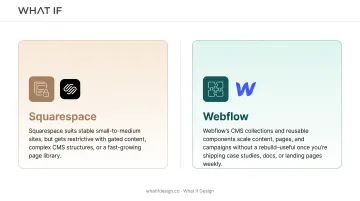
- Squarespace suits stable small-to-medium sites, but gets restrictive with gated content, complex CMS structures, or a fast-growing page library.
- Webflow's CMS collections and reusable components scale content, pages, and campaigns without a rebuild: useful once you’re shipping case studies, docs, or landing pages weekly.
2. What is Squarespace?
Squarespace is an all-in-one website builder. Hosting, templates, SSL security, and support all come bundled into one subscription, so it appeals to founders who want to launch fast without touching a line of code.
For a startup, that bundling shows up in a few practical ways:
- Faster time-to-launch since there's no infrastructure to configure
- No security or update chores, because Squarespace handles both in the background
- Built-in tools for blogging, basic e-commerce, and email marketing, all under one login
Squarespace has also rolled out AI design and copy tools that speed up first-draft site creation, which matters a lot when your founding team is two people and nobody has a marketing hire yet.
2.1 Use cases of Squarespace for startups
Squarespace fits best at the earliest stage of a company's life:
- Pre-seed and idea-stage landing pages meant to validate demand before building anything
- Founder portfolios or personal brand sites
- Simple service-based businesses testing a market before scaling operations
That makes it a strong fit for D2C brands, solo-founder service businesses, and content-first startups with a straightforward product story. Technical or fundraising-heavy startups usually outgrow it faster, especially when the site has to explain a complex product, architecture, or multi-stakeholder narrative.
The customer base matches that early-stage profile: the company reported more than 5.2 million unique subscriptions in Q2 2024, up 21% year over year. That's a huge base of small businesses and solo operators, not enterprise engineering teams.
How we evaluated the options
Every recommendation here comes from actual client work, brand systems shipped, websites launched, and product experiences delivered under fundraising deadlines. We compared the options against five criteria that matter most for technical founders:
- Total cost of ownership across the first 12 months (not just the sticker price)
- Speed to a usable output given a typical Series A runway
- Quality of the technical translation, can they explain your science without oversimplifying it?
- Rework risk, how often teams re-hire because the first choice couldn't scale
- Ability to move with the roadmap without a re-onboarding tax every quarter
Where we cite numbers or trade-offs below, they come from projects we've delivered or watched founders navigate first-hand.
3. What is Webflow?
Webflow is a professional no-code platform that combines visual design, a built-in CMS, and clean code output. Startups use it to move fast without sacrificing design quality, especially once investors start evaluating the site.
Operationally, Webflow offers:
- Faster design-to-publish cycles, so designers build and ship without a developer handoff
- Stronger technical SEO control, including meta tags, canonical URLs, and sitemap structure
- CMS structures that scale as content and product complexity grow
💡 Working through this decision right now? If you're a climate-tech or deep-tech founder weighing this trade-off, Book a strategy call with our team, 25 minutes, no pitch, and we'll pressure-test your specific situation.
Those strengths make Webflow a common default for startups with complex products or science-heavy value propositions. When you're trying to explain carbon capture chemistry or a battery management system to a nontechnical investor, a rigid template usually can't carry that weight.
3.1 Use cases of Webflow for startups
Webflow shows up most often at the growth stage, powering:
- Investor-facing marketing sites that need to build credibility fast
- SaaS landing pages optimized for conversion
- Product-led growth sites with frequent iteration
- CMS-driven blogs and case study libraries that scale into the hundreds of pages
Venture-backed SaaS, deep tech, and climate tech companies often use it to translate complex science or product architecture into something a partner or VC can grasp in thirty seconds.
After migrating to Webflow, Typeform's technical SEO health score jumped from 48 to 95. The marketing team then shipped 5 to 10 new landing pages within months, work that previously required developer bandwidth they didn't have.
See how we have approached this in practice: 10 Best Webflow agencies for branding & web development in 2026.
4. Squarespace vs Webflow: which is better for your startup?
There's no universal winner here. The right answer depends on four things:
- Your team's technical and design bandwidth: do you have a designer, or is it just founders?
- How complex your product story is: can you explain it in one sentence, or does it need visuals?
- Whether you're fundraising soon: investors judge credibility fast, and your site is part of that judgment
- How often your content and pages will change: weekly blog posts and case studies versus a static one-pager
Choose Squarespace if you're pre-seed, solo or two-founder, and need a professional site live within days on a tight budget. It gets you off the ground without eating your runway.
Choose Webflow if you have (or plan to hire) design support, expect to scale content and pages, or need to communicate a technical value proposition to investors who need convincing.
Many startups actually start on Squarespace and migrate once they raise a round. The usual trigger is outgrowing the platform: the product has three modules now instead of one, the content team wants to publish weekly, or the pitch deck says things the website can't yet visually back up.
Vanta, for example, saw a 43% increase in non-branded search traffic after moving its site to Webflow. That kind of SEO lift becomes a priority once you're past the earliest stage.
5. Real-world example: A climate tech startup's platform decision
Susteon is a climate tech incubator scaling low-carbon solutions across carbon capture, hydrogen production, and CO2 management. Its technology was sophisticated. Its website wasn't translating that sophistication into a story anyone outside the company could follow.
That's a common trap for deep tech founders. The science is real and defensible, but a template-driven site built for speed rarely has the storytelling tools to make it land with investors or partners.
What if Design led a four-month brand and website redesign in Figma, Webflow, and Spline. The goal was to rebuild the narrative from the ground up.
The site had to explain, in plain language, how Susteon's Sustenol™ technology captures over roughly 97% of CO2 from industrial flue gas at roughly 44% lower cost than conventional methods, without burying those numbers in jargon. That level of narrative control and interaction design is where template builders start to strain, and why the team chose Webflow.
The rebuild used Webflow-specific capabilities:
- CMS collections for technical docs and case studies the client can update without code
- Custom scroll and hover interactions to show processes you can't see, like industrial-scale gas capture
- Code export flexibility so the client's stack stays portable long-term
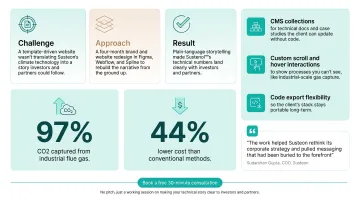
Sudarshan Gupta, COO of Susteon, Sudarshan Gupta, said the work helped the company "rethink its corporate strategy" and pulled messaging that had been buried "to the forefront."
For technical, funding-stage startups, dense science rarely fits a brochure-style template. It needs a canvas built for storytelling: structure, motion, and CMS depth that Webflow supports more readily than tools optimized for speed-to-launch alone.
If your website is underselling your science, book a free 30-minute consultation with What if Design. No pitch, just a working session on making your technical story clear to investors and partners.
Which option is right for your stage
The right answer depends less on the two options themselves and more on where you are as a company.
Pre-seed / seed (0–$3M raised): Speed and story matter more than polish. A focused boutique-agency sprint usually beats an in-house hire, because the founder still needs to control the narrative. We've seen this pattern with early climate-tech teams, a 4-to-6-week engagement to get brand, website, and pitch coherent is more valuable than a full-time designer.
Series A ($5–20M raised): This is where a senior-led agency partner pays for itself. You need a brand system that will survive three product pivots, a website that converts enterprise buyers, and pitch materials that hold up in board meetings. In-house is still premature unless you're planning to ship design-heavy product weekly.
Series B and beyond ($20M+ raised): Hire in-house design leadership and keep an agency partner for concentrated bursts (rebrands, launches, category shifts). The two aren't substitutes at this stage, they solve different problems.
Growth-stage climate tech specifically: The stakes shift once you're commercializing. Your brand needs to hold up to procurement diligence, regulatory scrutiny, and investor updates simultaneously. A specialist studio that already speaks the science, like our team, reduces the translation tax that generalists impose on every deliverable.
6. Conclusion
Neither platform is objectively better. Squarespace wins on speed and simplicity for early-stage, low-complexity needs. Webflow wins on flexibility, SEO depth, and scalability once a startup needs to communicate something more complicated than "we sell X."
Choose Squarespace if you need:
- A polished site live in days, not weeks
- Lower cost and light ongoing maintenance
- A straightforward product or service story
Choose Webflow if you need:
- Custom design for complex technical messaging
- Deeper SEO control and room to scale
- Stronger brand credibility for fundraising and partnerships
Match the platform to where your company sits today, and to the next 12 to 18 months of growth you're actually planning for.
A site that reflects the company you have actually become is the cheapest credibility you can buy, and it puts you back in control of the first impression. Get a free strategic audit.
7. Frequently asked questions
7.1 Is Webflow still relevant in 2026?
Yes. Webflow continues to ship feature updates across CMS, localization, and AI tooling, and remains a go-to platform for startups and agencies building custom, scalable sites.
7.2 Do professionals use Squarespace?
Yes, photographers, boutique brands, and solo consultants use it often. Agencies and technical teams tend to reach for it on simpler projects rather than complex, scalable builds.
7.3 Can I migrate my website from Squarespace to Webflow later?
Yes, and it's common. There's no automated import, so content, SEO settings, and design need to be manually rebuilt, which is a typical step once a startup outgrows Squarespace.
7.4 Is Webflow more expensive than Squarespace for a startup?
Entry-level pricing is similar. Webflow costs rise as CMS items, traffic, and paid seats increase, while Squarespace stays predictable at small scale.
7.5 Do I need a developer or designer to use Webflow?
No code is required, but Webflow's interface rewards design familiarity. That's why many startups partner with a design studio for their first build.
7.6 Which platform is better for an investor-facing startup website?
Webflow, thanks to its design flexibility and SEO control. That matters most for startups with technical or complex value propositions that need to build credibility fast.
Ready to take the next step?
If you're weighing a design partner for climate, deep tech, or hard-to-explain products, Book a strategy call with our founders at What if Design, a no-pressure 25-minute conversation about what you're building and where design can help. You can also View our work to see how we've helped teams like yours, or Get a free strategic Audit of your current brand, website, or product experience.