Meanwhile, consumers aren't buying it either. More than half of consumers globally believe brands mislead them on sustainability, according to Kantar's 2023 Sustainability Sector Index, based on 26,000 interviews across 42 sectors.
For climate tech, deep tech, and sustainability founders, this creates a real bind. How do you talk about genuine environmental impact without sounding like every competitor using the same buzzwords, or without accidentally claiming more than you can prove? This article breaks down the real difference between authentic sustainability branding and spin, the red flags of greenwashing and its quieter cousin greenhushing, and a practical framework for building a brand that survives scrutiny.
TL;DR: key takeaways
- Real sustainability claims are specific, dated, and evidenced, spin leans on vague adjectives with no proof
- EU rules are turning unsubstantiated green claims from a reputational risk into a legal liability
- Greenwashing and greenhushing share the same root cause: a credibility gap between what's said and what's proven
- Purpose-driven brands with high perceived sustainability value grew roughly 20% faster over four years than peers, per Kantar BrandZ data
- Climate tech founders need to translate real science into brand language people outside the lab can actually trust
1. Why sustainability branding is under the microscope right now
Sustainability claims used to live in a gray zone. Not anymore.
1.1 The regulatory net is tightening
Directive (EU) 2024/825 now prohibits:
- Generic environmental claims that lack recognized proof
- Sustainability labels without a real certification scheme behind them
- Offset-based claims of neutrality or positive climate impact
Future-performance claims require public, verifiable commitments with measurable, time-bound targets and independent verification.
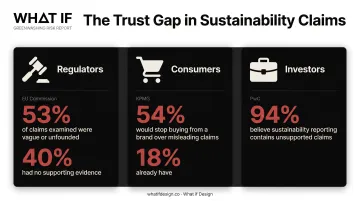
The European Commission found the scale of the problem before writing the rule: roughly 53% of green claims it examined were vague, misleading, or unfounded, and roughly 40% had no supporting evidence at all.
The ASA's 2024 ruling against Virgin Atlantic's "roughly 100% sustainable aviation fuel" claim, and its earlier action against Shell, show this isn't theoretical. Enforcement is already happening.
1.2 Consumers have stopped giving brands the benefit of the doubt
KPMG's 2023 UK survey found that roughly 54% of consumers would stop buying from a brand caught making misleading sustainability claims, and roughly 18% already had. Trust, once lost here, doesn't come back with a rebrand.
1.3 The stakes are higher for climate tech
For climate tech and deep tech companies, the audience isn't just retail shoppers scanning a label. It's:
- Investors running technical due diligence before a term sheet
- Enterprise buyers vetting claims as part of procurement
- Partners and regulators who need proof, not adjectives
PwC's 2023 Global Investor Survey found 94% of institutional investors believe sustainability reporting contains unsupported claims. When your buyer is an investment committee instead of a consumer, spin gets caught faster and costs more.
2. Real vs. spin: what actually separates authentic sustainability branding from greenwashing
Spin sounds good and proves nothing. It's "eco-conscious," "green," or "sustainable" used as decoration, with no data, methodology, or third-party check behind it. It travels well on a landing page and falls apart under a single follow-up question.
Real sustainability branding is specific, quantified, time-bound, and traceable. It points to an actual process, audit, or certification a skeptic can go verify.
2.1 The substantiation test
Before any sustainability claim goes on a website, deck, or ad, ask one question: can we produce the evidence behind this on demand? If the answer requires a caveat, a "well, technically," or a call to legal, the claim isn't ready.
This matters because most companies talk a better game than they execute. IBM's 2024 survey of 5,000 C-suite executives across 22 countries found that 76% call sustainability central to strategy, but only 30% report meaningful progress executing it, and 47% struggle to fund the work at all.
💡 Working through this decision right now? If you're a climate-tech or deep-tech founder weighing this trade-off, Book a strategy call with our team, 25 minutes, no pitch, and we'll pressure-test your specific situation.
Brand language that outruns that execution gap is exactly what regulators and investors are now trained to spot.
2.2 Real vs. spin at a glance
| Spin Markers | Real Markers |
|---|---|
| Vague adjectives ("green," "natural") | Specific, quantified numbers |
| No supporting data | Disclosed methodology |
| Inconsistent across channels | Consistent across product, ops, and marketing |
| Decorative green visuals | Third-party validation or audit |
See how we have approached this in practice: Sustainability branding.
3. Red flags: how to spot greenwashing (and greenhushing)
Some warning signs are loud. Others are silence itself.
- Vague, unsubstantiated language: "sustainable" or "natural" with no data or standard attached
- Selective disclosure: one strong metric highlighted while bigger negative impacts elsewhere go unmentioned
- Irrelevant claims: a minor eco-feature spotlighted to distract from the product's actual footprint
- Aesthetic-only greenwashing: leaf icons and green palettes standing in for proof
- Greenhushing: going quiet about real progress out of fear of scrutiny
That last one is more common than most founders realize. South Pole's 2023/24 survey of over 1,400 companies found that 9 of 14 sectors were actively cutting climate communications. Among those finding it hardest, roughly 58% deliberately planned to say less externally. That's despite roughly 81% agreeing that net-zero communication is good for the bottom line.
Greenhushing has a real cost. Brands leave credibility and commercial value on the table just to avoid hard questions.
4. The hallmarks of real sustainability branding
Authentic sustainability branding shows up the same way in five places, not just one.
4.1 Specificity over adjectives
Dated, quantified, independently verifiable claims replace generic language. "Carbon neutral" becomes "verified to remove 12,000 tons of CO2 annually, audited by a named third party."
4.2 Consistency across the whole brand
The story has to show up in product design, operations, and internal culture, not just the marketing page. If the website says one thing and the supply chain says another, someone will eventually notice.
4.3 Honest technical translation
For climate tech and deep tech companies, this is where most brands stumble. The science is real, but explaining it accurately, without dumbing it down or inflating it, takes real work.
At What if Design, co-founder Akhila Kosaraju's approach with climate tech and hard-tech founders starts by learning the underlying science and market before any design work begins. That grounding shows in projects like Susteon, a carbon-capture and utilization company.
What if Design translated Susteon's deeply technical work into clearer brand and website messaging. COO Sudarshan Gupta said the process prompted the company to "reflect and rethink" its own corporate strategy.
HYDGEN's rebrand took the same route. It framed decentralized hydrogen production around proprietary AEM and PEM electrolyzers, with specific technical detail rather than generic clean-energy language. Investors and partners got something concrete to evaluate.
4.4 Evidence-based storytelling
Case studies, real data visualizations, and recognized third-party certifications like B Corp or Science Based Targets carry more weight than any tagline.
4.5 Leadership living the values
Founders whose public decisions match the brand's stated commitments are the final, hardest-to-fake signal.
5. A practical framework for building an authentic sustainability brand
Building a brand that survives scrutiny is an ongoing process, not a one-off campaign.
- Audit existing claims against evidence. Go through every sustainability claim on your site, deck, and marketing materials. Flag anything you couldn't defend if a journalist or investor asked for proof tomorrow. 2.
Align brand voice with actual operations. Your visual identity and messaging should reflect what's actually true in your product, supply chain, and process, not an aspirational version of it. 3. Choose partners who understand both the science and the story. Brief them on real constraints and evidence, not only the vision deck. Look for teams that learn the tech first and can turn complex climate or deep-tech work into brand and website narratives that hold up in funding and partnership conversations. The kind of hard-to-write brief What if Design takes on for these companies.
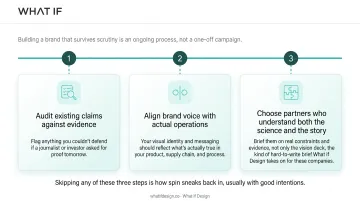
Skipping any of these three steps is how spin sneaks back in, usually with good intentions.
When the story is clear, the next conversation starts from confidence rather than explanation. Get a free strategic audit.
6. Frequently asked questions
6.1 What is the difference between sustainability branding and greenwashing?
Sustainability branding uses specific, verifiable claims backed by data or certification. Greenwashing relies on vague, feel-good language like "eco-friendly" with no evidence behind it.
6.2 What is greenhushing and why does it matter?
Greenhushing is when companies stay quiet about real sustainability progress out of fear of criticism. It erodes trust just as much as overclaiming, and it forfeits the commercial upside of honest communication.
6.3 How can I tell if a company's sustainability claims are genuine?
Look for specific numbers, disclosed methodology, and third-party verification. Genuine claims also stay consistent across the product, operations, and marketing, not just the homepage.
6.4 What certifications indicate a genuine sustainability commitment?
B Corp Certification, Science Based Targets (SBTi), and roughly 1% for the Planet are widely recognized third-party accountability signals, each verifying a different layer of company or target-level performance.
6.5 Why do purpose-driven brands perform better commercially?
Kantar BrandZ What we see in practice is brands with high perceived sustainability value grew roughly 20% faster over four years than low-scoring peers. Consumers and talent increasingly favor companies with credible purpose.
6.6 How often should a company review its sustainability messaging?
At least annually, and immediately after any regulatory change like the EU's green claims rules. Evidence, certifications, and operations shift faster than most marketing pages get updated.
Ready to take the next step?
If you're weighing a design partner for climate, deep tech, or hard-to-explain products, Book a strategy call with our founders at What if Design, a no-pressure 25-minute conversation about what you're building and where design can help. You can also View our work to see how we've helped teams like yours, or Get a free strategic Audit of your current brand, website, or product experience.