Get it wrong, and you'll feel it later. McKinsey's 2024 analysis of more than 1,700 product teams across 75 organizations found that teams with fully dedicated members, who weren't context-switching between unrelated projects, delivered more consistent estimates and faster throughput than fragmented teams (McKinsey, 2024). The same logic applies to design resourcing. This article breaks down when a point vendor makes sense, when you need an enterprise design partner, and how founders at companies like Susteon and HYDGEN have navigated that choice.
TL;DR: key takeaways
- Enterprise design partners treat brand, website, and product as one system; point vendors handle single, well-defined tasks.
- Pick based on company stage, how technical your story is, and whether you need long-term strategic alignment.
- Point vendors cost less per task, but costs stack fast once you manage four or five of them.
- Most climate tech founders start fragmented, then consolidate around one partner as fundraising and product complexity grow.
1. Enterprise partner vs. point vendors: quick comparison
Before the definitions, here's how the two models stack up on the factors founders actually care about.
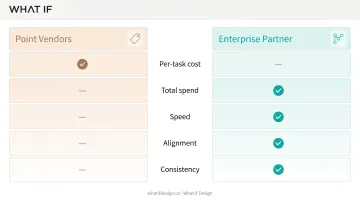
| Factor | Enterprise Partner | Point Vendors |
|---|---|---|
| Cost | Higher upfront retainer, but consolidated scope lowers total spend across brand, web, and product over time | Lower per-task cost, but expenses compound as more vendors join for each new deliverable |
| Strategic Alignment | Deep understanding of your business goals, technology, and investor narrative across every touchpoint | Limited context per project; each vendor optimizes only their own piece |
| Speed & Agility | Faster iteration since one team retains institutional knowledge and owns the full workflow | Slower, since every new vendor needs onboarding and re-explaining of context |
| Consistency & Scalability | One visual and UX language across brand, website, and product as you scale | Higher risk of fragmented branding and inconsistent experience across channels |
Point vendors win on isolated per-task cost. Enterprise partners pull ahead once you're stringing brand, web, and product deliverables together: on total spend, speed, alignment, and consistency.
2. What is an enterprise design partner?
An enterprise design partner is a long-term, full-service creative collaborator that embeds with your strategy. Instead of taking a brief and executing it, they help write the brief. That distinction matters enormously in climate tech, where the "product" might be a carbon capture reactor or a green hydrogen electrolyzer that most designers, and most investors, have never seen before.
This model earns its keep when the technical story itself is hard to tell. Founders working on grid interconnection, direct air capture, or battery chemistry don't just need a nice-looking website. They need someone who understands the science well enough to decide what to simplify and what to keep.
Core operational benefits include:
- Faster fundraising cycles, since decks, websites, and product UX tell one consistent story
- Stronger investor and partner trust from a cohesive, credible presentation
- Reduced internal management overhead compared to juggling multiple freelancers and chasing revisions
McKinsey's 2022 study of design departments across more than 100,000 teams found that organizational integration, not headcount, was the hallmark of high-performing design functions (McKinsey's redesign of the design department). The same principle applies externally: a partner embedded in your strategy outperforms a vendor bolted onto your workflow.
Some partners specialize vertically in climate tech and deep-tech: carbon capture, green hydrogen, ESG data platforms, while others work horizontally across unrelated industries and pick up whatever project comes through the door.
2.1 Use cases of an enterprise design partner
This model tends to show up at specific inflection points in climate tech, ESG, EV/battery, and other deep-tech ventures:
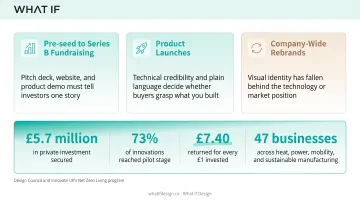
- Pre-seed to Series B fundraising: pitch deck, website, and product demo must tell investors one story
- Product launches: technical credibility and plain language decide whether buyers grasp what you built
- Company-wide rebrands: visual identity has fallen behind the technology or market position
There's sector-level evidence for sustained design support. The Design Council and Innovate UK's Net Zero Living program worked with 47 businesses across heat, power, mobility, and sustainable manufacturing, offering ongoing design coaching rather than one-off deliverables.
A year later, participants had secured £5.7 million in private investment, 73% of innovations reached pilot stage, and the program reported £7.40 returned for every £1 invested (Design Council). It isn't a controlled test against fragmented vendors, but it strongly links design continuity to commercialization outcomes.
If your site hasn't kept pace with where the business actually is, we can show you what that's costing you. Get a free strategic audit.
3. What is a point vendor?
A point vendor is a specialized provider delivering one well-scoped service. Think a freelance illustrator, a logo designer, a dev shop building a single feature, or a no-code design tool. There's no ongoing strategic relationship, just a task and a deadline.
This model works well when the task is narrow and doesn't require deep context about your company. You don't need someone who understands your Series A narrative to design a conference banner.
Core benefits include:
- Lower cost for isolated, well-defined tasks
- Quick turnaround with no strategy onboarding curve
- Flexibility to swap vendors between projects without contractual lock-in
Variations include freelance marketplaces, boutique single-service agencies, and template-based design tools like Canva or Figma community kits.
3.1 Use cases of point vendors
Point vendors fit naturally into a few scenarios:
- Quick MVP mockups to test an idea before committing budget to a full brand
- One-off marketing assets, like a social campaign or investor one-pager
- Temporary skills gaps, such as needing an illustrator for two weeks
Bootstrapped early-stage startups testing a hypothesis often lean here, as do established companies that just need one campaign asset and already have a stable brand system.
The risk shows up over time. Without a shared design system, visual language drifts across every new vendor's output. Each freelancer optimizes for their own deliverable, not the bigger picture. Fixing that inconsistency later, through a rebrand or full site rebuild, almost always costs more than getting it right the first time.
4. Enterprise partner vs. point vendor: which is better?
There's no universal answer. The right call depends on a few factors:
- Company stage: Are you testing an idea or preparing for a funding round?
- Complexity of your technical story: Can a generalist understand your product in an afternoon, or does it require weeks of context?
- Budget structure: Do you prefer predictable retainers or pay-as-you-go project fees?
- Need for cohesion: Will your brand, website, and product need to speak with one voice as you scale?
Choose point vendors if you need one isolated deliverable, fast and cost-effective, and you don't need it to connect to a broader story yet.
Choose an enterprise partner if you're raising capital, launching a complex product, or need your brand and product experience to stay consistent as your team grows.
Here's what that second path looks like in practice.
4.1 A real example: Susteon
Susteon, a carbon capture and hydrogen technology company, struggled with a common problem: its existing website didn't explain what it actually did. The science, spanning carbon capture, hydrogen production, and CO2 management, was too dense for the investors and partners it needed to reach.
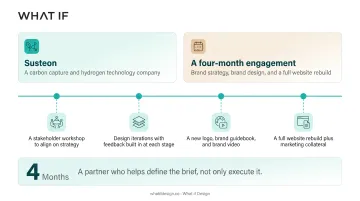
What if Design took on a four-month engagement covering brand strategy, brand design, and a full website rebuild. The work included:
- A stakeholder workshop to align on strategy
- Design iterations with feedback built in at each stage
- A new logo, brand guidebook, and brand video
- A full website rebuild plus marketing collateral
According to COO Sudarshan Gupta, the result wasn't just a better-looking site. It pushed Susteon to rethink corporate strategy and messaging so the vision landed with the audiences that mattered most. That's what you get when a partner helps define the brief, not only execute it.
If your company is approaching a raise or launch and your current design setup feels like it's held together with duct tape, that's usually the signal to consolidate.
5. Conclusion
Point vendors earn their place for narrow, well-defined tasks: a logo, a landing page, a single campaign asset. They're fast and cost-effective precisely because they don't carry the weight of your full story.
Once brand, website, and product experience need to move together: whether you're fundraising, launching, or scaling past a patchwork of freelancers, an enterprise design partner stops being optional.
The decision comes down to what you're optimizing for. If it's a quick fix, hire a point vendor. If it's fundraising velocity, brand credibility, and fewer hours spent managing five different Slack channels, a dedicated partner who understands your technology and your market will save you more than it costs.
Clarity here is what turns a defensive conversation into a confident one. Get a free strategic audit.
6. Frequently asked questions
6.1 What does an enterprise design partner do?
An enterprise design partner manages brand, website, and product design as one connected system, aligning every touchpoint with your business and fundraising goals. Rather than delivering isolated tasks, they embed with your strategy over time.
6.2 What is an enterprise design partner contract?
These are typically structured as ongoing retainers, often month-to-month, covering a defined scope across multiple deliverables rather than a single project. This contrasts with point vendors, who usually work under one-time project agreements.
6.3 How much does an enterprise design partner cost compared to point vendors?
Point vendors have lower costs per individual task. Enterprise partners often reduce total cost of ownership over time by eliminating the redundant work, rework, and miscommunication that come from managing multiple disconnected vendors.
6.4 Can a company use both point vendors and an enterprise design partner?
Yes, hybrid approaches work for supplemental, one-off needs alongside an existing partner relationship. That said, most companies consolidate toward a single partner as complexity and coordination demands grow.
6.5 When should a climate tech startup switch from freelancers to a design partner?
Common triggers include an upcoming funding round, a major product launch, or noticing that your brand looks inconsistent across your website, deck, and marketing materials. Any of these signals it's time for cohesion.
6.6 What's the difference between a design agency and a design partner?
A design partner embeds deeply and stays involved long-term, learning your business and technology in depth. A traditional agency typically executes defined projects on a shorter-term basis without that ongoing strategic involvement.
Related reading: Mobile UX design and What expert UX actually looks like.
Ready to take the next step?
If you're weighing a design partner for climate, deep tech, or hard-to-explain products, Book a strategy call with our founders at What if Design, a no-pressure 25-minute conversation about what you're building and where design can help. You can also View our work to see how we've helped teams like yours, or Get a free strategic Audit of your current brand, website, or product experience.