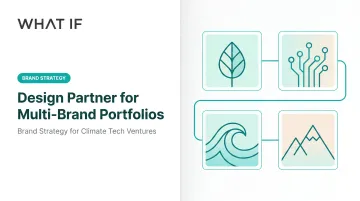
Each company hires its own designer or agency. Each one starts from zero.
The result: inconsistent quality across the portfolio, timelines that stretch for weeks longer than they should, and budgets that pay for the same discovery work over and over. This article breaks down what a multi-brand design partner actually does, what separates a good one from a mediocre one, and how this model plays out in real venture and climate-tech portfolios.
TL;DR: key takeaways
- A multi-brand portfolio needs one embedded design partner, not a rotating cast of vendors, to protect quality and speed
- Each portfolio company often speaks to a different buyer (investor, regulator, enterprise procurement) even under one parent organization
- The strongest partners combine systems thinking with the ability to learn technical subject matter fast
- Full-service partners (brand, website, product UX) cut the number of vendors a portfolio operator has to manage
1. What is a design partner for multi-brand portfolios?
A multi-brand portfolio is any structure where one organization oversees several distinct brands. That could be a consumer goods company running a house of brands, or a venture capital firm and its entire batch of funded startups.
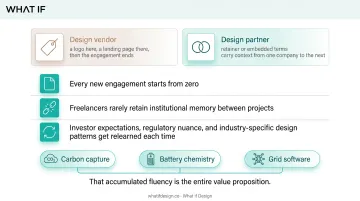
A design partner is different from a design vendor. Vendor relationships are project-based: a logo here, a landing page there, then the engagement ends. A design partner works on retainer or embedded terms, staying close enough to the portfolio to carry context from one company to the next.
That distinction matters more than it sounds.
Why single-brand agencies struggle to scale across a portfolio:
- Every new engagement starts from zero. No shared vocabulary, no accumulated understanding of the portfolio's technical domain
- Freelancers rarely retain institutional memory between projects, so lessons learned at Company A never reach Company B
- Investor expectations, regulatory nuance, and industry-specific design patterns get relearned each time
A partner who's already spent months inside carbon capture, battery chemistry, or grid software doesn't need a crash course when the next portfolio company shows up with a similar brief. That accumulated fluency is the entire value proposition.
That fluency shows up most clearly when each portfolio company needs its own B2B brand identity, not a recycled template.
1.1 B2B brand identity across portfolio companies
B2B brand identity is the visual and verbal system (logo, positioning, messaging, and tone) built to earn trust with business buyers, investors, and technical stakeholders rather than individual consumers.
This distinction matters inside a portfolio because every company may talk to a different audience: an investor for one, an enterprise procurement team for another, a regulator for a third.
McKinsey's research across 90 B2B companies and 700+ executives found that honest, open dialogue ranked as the most important trust factor for buyers, yet suppliers consistently underemphasized it. A generic "corporate" identity doesn't fix that gap. A brand built around clarity and credibility does.
2. Why multi-brand portfolios struggle without a dedicated design partner
Three problems show up almost immediately once portfolio companies start hiring design help independently.
Fragmented identity dilutes trust. When each company picks its own agency, quality swings wildly from one brand to the next. A polished Series B startup sits next to a company with a template website, and the parent organization's reputation absorbs the gap. Buyers and co-investors notice.
Speed to market slows to a crawl. Every new brand starts its design process from scratch instead of building on a proven, reusable framework. Discovery gets repeated. Brand strategy gets repeated. Nothing compounds.
Cost inefficiency compounds across the portfolio. Funding an in-house designer at every portfolio company, or paying full agency rates repeatedly, adds up fast.
82% of ANA-surveyed companies had an in-house agency in 2023, up from just 42% in 2008. Organizations want centralized creative capability, not scattered outside help. A shared senior-level partner delivers that benefit without hiring overhead at every company.
These problems follow from treating design as disconnected transactions instead of an ongoing relationship.
3. What to look for in a design partner for multi-brand portfolios
Not every agency can operate at portfolio scale. Here's what separates a capable partner from one that will slow you down.
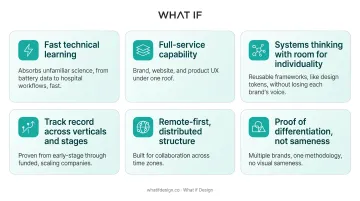
Fast technical learning. In deep tech, climate tech, or regulated industries, the brief is often hard to write because founders are still refining how they explain the science. A partner needs to absorb unfamiliar territory quickly: battery state-of-charge data, ESG vendor categorization, hospital asset-maintenance workflows, and turn it into something a non-expert buyer understands.
Full-service capability. Brand, website, and product UX under one roof means portfolio companies aren't coordinating three vendors, three timelines, and three invoices.
Systems thinking with room for individuality. The best partners build reusable frameworks: shared design principles and modular components, much like design tokens that let teams theme a product without rebuilding the foundation. Each brand keeps its own voice; the scaffolding doesn't get rebuilt every time.
A track record across verticals and stages. Look for evidence of work spanning early-stage companies through funded, scaling ones. Portfolio needs shift as companies mature, and a partner should have handled both ends.
Remote-first, distributed structure. Portfolio companies rarely sit in one city, let alone one time zone. A partner built for distributed collaboration keeps things moving regardless of geography.
Proof of differentiation, not sameness. Ask to see multiple brands built under one methodology. If they all look identical, treat that as a warning sign.
If your site hasn't kept pace with where the business actually is, we can show you what that's costing you. Get a free strategic audit.
4. Examples of multi-branding in practice
Multi-branding isn't a new concept. LVMH operates more than 75 Maisons under one parent, and each one maintains its own identity while the group shares resources and operational infrastructure behind the scenes. That's the governance tension every multi-brand portfolio has to solve: shared capability, distinct expression.
4.1 Multi-branding in venture and climate tech portfolios
VC firms and accelerators function as multi-brand portfolios in practice, even if nobody calls them that. Each funded startup is its own brand with its own audience, but the investor benefits when design quality and speed stay consistent across the batch.
This platform model already exists in venture. Firms that publicly describe shared operating support across portfolio companies include:
- a16z
- GV
- Designer Fund
That support often spans marketing, talent, and brand strategy, built once, then delivered across companies instead of rebuilt for each one.
The same pattern is common in climate tech and deep-tech investing, where the science is hard to communicate. A BCG and Hello Tomorrow survey of 116 deep-tech ventures and investors found that 81% of founders believed investors lacked the scientific or engineering expertise needed to assess their technology.
Multiple hard-science startups in one portfolio hit that translation problem at once. That is the gap a dedicated design partner is meant to close.
5. Why climate tech and VC-backed portfolios choose a specialized partner like What if Design
What if Design was built by two co-founders with complementary backgrounds.
Akhila Kosaraju designed LEED buildings and $100M+ urban interventions before applying that architect’s systems-thinking to climate tech branding. Tejas Mahajan leads product and UX for software companies, designing for adoption, retention and the metrics that drive growth, across battery management systems, fleet platforms and ESG tools. An operational lens that now shapes how the firm approaches product UX at scale.
That mix of spatial systems-thinking and operations experience maps directly onto multi-brand portfolios: technical companies that must move fast without letting quality slip.
5.1 Senior-level expertise without hiring overhead
For VCs and portfolio operators juggling several design needs at once, the practical value is simple: strategic design thinking without recruiting, onboarding, and managing an in-house designer for every company.
5.2 Track record in technical, high-stakes work
What if Design has worked with teams backed by the U.S. Department of Energy, ARPA-E, and leading climate VCs, contributing to over $105M raised. That work spans:
- Susteon: brand strategy, logo design, and full website redesign
- LabStart: climate-venture-studio positioning and a lab-to-market website
- HYDGEN: refined visual identity plus a technically detailed product website
- Ribbit Network: a website built around GHG tracking and climate observability
The firm has also worked well outside typical branding territory:
- Batteryze, circular EV-battery platform tracking daily fleet performance
- Vested Futures, ESG and carbon-management vendor tooling
- Saudi Arabia’s Ministry of Health, nationwide healthcare asset-management system
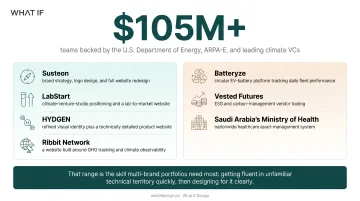
That range is the skill multi-brand portfolios need most: getting fluent in unfamiliar technical territory quickly, then designing for it clearly.
5.3 Full-service model, less vendor sprawl
Brand, website, and product UX under one team means a portfolio operator isn’t managing three separate contracts for every company.
5.4 Mission alignment for climate portfolios
we are a signatory to Design Declares, a public commitment to using design for environmental and social impact. For climate-focused and purpose-driven portfolios, that membership is a concrete signal of shared priorities.
A site that reflects the company you have actually become is the cheapest credibility you can buy, and it puts you back in control of the first impression. Get a free strategic audit.
6. Frequently asked questions
6.1 What is a B2B brand identity?
B2B brand identity is the visual and messaging system: logo, positioning, and tone, built to earn trust with business buyers, investors, and technical stakeholders rather than individual consumers.
6.2 What is an example of multi-branding?
LVMH's 75+ Maisons under one corporate parent is one example. A VC firm's entire funded startup portfolio, each a distinct brand under one investor's umbrella, is another.
6.3 How much does it cost to hire a design partner for a multi-brand portfolio?
Costs vary by scope, portfolio size, and technical complexity. As a general rule, a shared senior-level partner costs less than funding separate in-house design hires at every portfolio company.
6.4 How is a multi-brand design system different from a single-brand style guide?
A style guide documents how one brand should look. A multi-brand design system adds shared core principles plus flexible theming layers, letting each brand express its own identity without rebuilding the foundation.
6.5 Should every company in a portfolio have a completely separate identity, or share some design elements?
Each company should keep its own visual identity and voice. Sharing underlying design principles and reusable components, not the visible branding itself, is where the efficiency comes from.
6.6 How long does it take to build a design system across a multi-brand portfolio?
Timelines depend on portfolio size and technical complexity. A single foundational brand identity typically takes 4-6 weeks; a full shared system across multiple companies takes longer and should be scoped project by project.
Related reading: 10 Best SaaS UX Design Agencies For Product Growth In 2026 and Discover the top UI/UX design agencies in Bangalore.
Ready to take the next step?
If you're weighing a design partner for climate, deep tech, or hard-to-explain products, Book a strategy call with our founders at What if Design, a no-pressure 25-minute conversation about what you're building and where design can help. You can also View our work to see how we've helped teams like yours, or Get a free strategic Audit of your current brand, website, or product experience.