Where What if Design fits in We're a senior-led creative studio built specifically for climate tech, clean tech, and deep tech founders. Since 2020, we've partnered with teams like HYDGEN, Ribbit Network, and Susteon to turn hard-to-explain technology into brands, websites, and product experiences that raise capital and win adoption. This comparison reflects how we evaluate the trade-offs when a founder asks us which route to take.
"Agency" and "design-as-a-service" both promise to solve your design problem, but they're built for different jobs. One gives you a strategic partner. The other gives you fast, predictable execution.
Picking the wrong one costs more than money. It affects how fast you move, how much strategic thinking you get, and whether your brand actually holds up under investor or customer scrutiny. For a generic ecommerce store, the calculus looks nothing like it does for a climate tech startup trying to explain carbon capture chemistry to a Series A investor.
This guide breaks down exactly how these models differ, where each one wins, and how to decide which fits your business right now.
TL;DR: key takeaways
- Agencies deliver strategic, multidisciplinary work via project or retainer pricing for complex brand challenges.
- Design-as-a-Service (DaaS) offers fixed monthly pricing for fast, recurring design with limited strategic input.
- Your decision hinges on work complexity, request volume, and domain expertise needs.
- Boutique specialist studios blend agency-level strategy with subscription agility for niche technical sectors.
1. Agency vs. design-as-a-service: quick comparison
| Factor | Agency | Design-as-a-Service |
|---|---|---|
| Cost | Project or retainer-based; higher investment reflecting strategy and senior involvement | Fixed monthly subscription; generally lower and predictable |
| Team Structure | Multidisciplinary team (strategists, designers, PMs) assigned to your account | Rotating or dedicated remote designer(s) pulling from a request queue |
| Strategic Involvement | Deep involvement in business goals, positioning, and brand direction | Executes defined requests with limited strategic input |
| Turnaround & Scope | Longer timelines for comprehensive work (branding, product, campaigns) | Fast turnaround, often 24-48 hours, for smaller recurring tasks |
| Best Fit | Complex, high-stakes projects needing technical or specialized understanding | High-volume, ongoing marketing collateral |
The table tells you the shape of each model. The next sections tell you when each one actually makes sense.
2. What is an agency?
An agency is a team of specialists: strategists, designers, and project managers, engaged on a project or retainer basis to deliver comprehensive design and brand work. Unlike a single freelancer or a queue-based service, an agency embeds itself in your business context before producing anything.
That embedded approach pays off in specific ways:
- Brand consistency across every touchpoint, because one team owns the whole system
- Investor and customer trust, built through cohesive positioning rather than piecemeal assets
- Long-term market differentiation, since strategy informs every design decision
2.1 Types of agencies
Not all agencies look the same. You'll typically find:
- Full-service agencies covering brand, web, and product under one roof
- Boutique or niche specialist agencies focused on a sector, such as fintech, healthcare, or climate tech
- Branding-only agencies limited to identity and messaging
- Digital-product or UX/UI agencies specializing in interfaces and user experience
Boutique specialist agencies bring senior-level strategic thinking to technical industries without the overhead of a large traditional shop. What if Design runs this model: full-service brand strategy, website design, and product design for climate tech and deep-tech startups.
That focus means less time explaining what "green hydrogen" or "carbon capture" means, and more time turning it into something investors immediately grasp.

2.2 When an agency fits
Agencies dominate when the work is complex enough that execution alone won't cut it. Think:
- Complex rebrands that require repositioning, not just a new logo
- Product launches with multiple stakeholders and messaging layers
- Fundraising collateral, including pitch decks and data rooms
- Multi-channel campaigns needing one coherent strategic thread
Technical startups feel this pressure most acutely. A climate tech company translating novel science into something a generalist investor can understand needs more than a template. It needs a partner who grasps the underlying technology and can frame the story clearly.
Take Susteon, a decarbonization technology incubator working across carbon capture, hydrogen production, and CO₂ management. What if Design spent four months building a brand and website around a "regenerative carbon ecosystem," with interactive diagrams and visual storytelling that connect technologies like their Electrified Atmospheric CO₂ Concentrator to renewable-energy integration.
The redesigned site drew 30% more applicants for open roles than the previous version. Clarity became a growth lever, not only an aesthetic upgrade.
On the investor side, the pressure to communicate quickly is real. DocSend's analysis of pre-seed pitch decks found investors spend an average of just 4 minutes and 10 seconds reviewing a deck, and only 1-roughly 2% of decks lead to a meeting. That window favors ruthless clarity over flashy graphics, exactly what strategic design partners are built to deliver.
If your site hasn't kept pace with where the business actually is, we can show you what that's costing you. Get a free strategic audit.
How we evaluated the options
Every recommendation here comes from actual client work, brand systems shipped, websites launched, and product experiences delivered under fundraising deadlines. We compared the options against five criteria that matter most for technical founders:
- Total cost of ownership across the first 12 months (not just the sticker price)
- Speed to a usable output given a typical Series A runway
- Quality of the technical translation, can they explain your science without oversimplifying it?
- Rework risk, how often teams re-hire because the first choice couldn't scale
- Ability to move with the roadmap without a re-onboarding tax every quarter
Where we cite numbers or trade-offs below, they come from projects we've delivered or watched founders navigate first-hand.
3. What is design-as-a-service?
Design-as-a-Service (DaaS) is a subscription model. You pay a fixed monthly fee, and a remote team handles ongoing, on-demand design requests, usually submitted through a queue or project management tool.
The appeal is operational, not strategic:
- Predictable budgeting: no scope creep, no surprise invoices
- Fast turnaround: routine requests often within 24-48 hours
- Scalability: ramp requests up or down without hiring, onboarding, or firing anyone
3.1 Types of daaS providers
Subscriptions aren't one-size-fits-all:
- General-purpose subscriptions covering social graphics, presentations, and basic collateral
- Specialized subscriptions focused narrowly on web design, motion/video, or illustration
3.2 Use cases of design-as-a-service
DaaS fits best where the work is recurring and relatively low in complexity:
- Social media graphics and ad creative produced on a weekly cadence
- Sales presentations and one-off marketing collateral
- Routine web updates that don't require a full redesign

Marketing teams, ecommerce brands, and SMBs are the natural home for this model. They generate high volumes of design requests, but most of those requests don't need a strategist in the room.
The cost math explains why. The Bureau of Labor Statistics reports a median annual wage of $61,300 for a full-time graphic designer, before benefits, equipment, or management overhead. Compare that to a live vendor pricing page like Penji's, which lists subscription tiers from $995 to $4,500 per month, roughly $11,940 to $54,000 annualized.
For high-volume, low-complexity work, that gap makes subscriptions an easy call. For strategic, technical work, that same math misses the point entirely, since subscriptions aren't priced or structured for deep domain expertise.
4. Agency vs. design-as-a-service: which is better for your business?
The right answer depends on four questions:
- How complex is the work? Rebrands and product design need strategy. Recurring social graphics don't.
- How frequent are your requests? High-volume, repetitive needs favor a subscription queue.
- Do you need strategic guidance or pure execution? Agencies think with you. DaaS builds what you already know you want.
- Does your industry require specialized domain knowledge? Regulated or technical sectors punish generic execution.
Choose an agency (or boutique specialist studio) if you're navigating a technical or regulated niche and need strategic brand, website, or product work. Choose DaaS if you need consistent, high-volume design output on a predictable budget.
4.1 The third path: boutique specialist studios
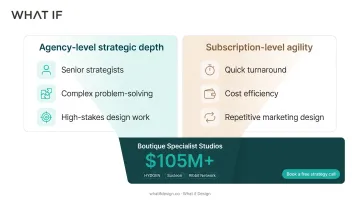
Specialized boutique studios sit in the middle: agency-level strategic depth with the agility and cost efficiency usually tied to subscriptions. What if Design was built for this gap, serving climate tech, deep tech, and sustainability companies that need senior strategic thinking and quick turnaround.
In 2021, as pandemic uncertainty reshaped how startups raised money, What if Design helped create a pitch deck for a portfolio company backed by a leading VC firm. The deck reportedly "spread like wildfire" and became an internal benchmark for the team.
That work grew into pitch and brand projects for climate tech clients: including HYDGEN, Susteon, and Ribbit Network, contributing to $105M+ raised.
Complex, high-stakes design work benefits from a strategic partner who understands your technology. Repetitive marketing design benefits from subscription efficiency. Rarely does one model serve both needs well.
If you're a climate tech or deep-tech founder trying to turn complicated science into a brand, website, or pitch deck that actually lands with investors, book a strategy call with What if Design. It's a free consultation, no sales pitch involved.
Which option is right for your stage
The right answer depends less on the two options themselves and more on where you are as a company.
Pre-seed / seed (0–$3M raised): Speed and story matter more than polish. A focused boutique-agency sprint usually beats an in-house hire, because the founder still needs to control the narrative. We've seen this pattern with early climate-tech teams, a 4-to-6-week engagement to get brand, website, and pitch coherent is more valuable than a full-time designer.
Series A ($5–20M raised): This is where a senior-led agency partner pays for itself. You need a brand system that will survive three product pivots, a website that converts enterprise buyers, and pitch materials that hold up in board meetings. In-house is still premature unless you're planning to ship design-heavy product weekly.
Series B and beyond ($20M+ raised): Hire in-house design leadership and keep an agency partner for concentrated bursts (rebrands, launches, category shifts). The two aren't substitutes at this stage, they solve different problems.
Growth-stage climate tech specifically: The stakes shift once you're commercializing. Your brand needs to hold up to procurement diligence, regulatory scrutiny, and investor updates simultaneously. A specialist studio that already speaks the science, like our team, reduces the translation tax that generalists impose on every deliverable.
5. Conclusion
Neither model wins outright. An agency isn't automatically "better" than a subscription, and a subscription isn't automatically cheaper. Match the model to how complex, frequent, and specialized your design needs actually are.
- Protecting a fundraising outcome or differentiating a technical product in a crowded market → agency or boutique specialist
- Shipping marketing assets weekly on a fixed budget and timeline → subscription
Know which problem you're solving before you pick a model.
A site that reflects the company you have actually become is the cheapest credibility you can buy, and it puts you back in control of the first impression. Get a free strategic audit.
6. Frequently asked questions
6.1 What are the different types of design agencies?
Agencies generally fall into full-service, boutique/niche specialist, branding-only, and digital product/UX agencies. Specialization often matters more than overall size when it comes to output quality.
6.2 What is the difference between a design agency and design-as-a-service?
Agencies provide strategic, project-based work with deep involvement in business goals. DaaS provides subscription-based, execution-focused design without ongoing strategic input.
6.3 Is design-as-a-service cheaper than hiring an agency?
DaaS typically has lower, fixed monthly costs. However, it usually doesn't cover complex strategic or highly technical projects that agencies are built to handle.
6.4 Can design-as-a-service handle branding or product design?
Some DaaS providers offer branding or product deliverables, but usually with less strategic depth, research, and stakeholder alignment than a dedicated agency provides.
6.5 How do I know if my company needs an agency instead of a design subscription?
Signals include complex or technical positioning, active fundraising, or the need for a cohesive multi-channel brand strategy. Simple, recurring design tasks rarely need this level of involvement.
6.6 Is design-as-a-service or an agency better for startups?
It depends on stage and complexity. Early-stage, high-volume marketing needs suit DaaS, while technical or fundraising-critical branding suits a specialized agency.
Related reading: 10 Best SaaS UX Design Agencies For Product Growth In 2026 and Discover the top UI/UX design agencies in Bangalore.
Ready to take the next step?
If you're weighing a design partner for climate, deep tech, or hard-to-explain products, Book a strategy call with our founders at What if Design, a no-pressure 25-minute conversation about what you're building and where design can help. You can also View our work to see how we've helped teams like yours, or Get a free strategic Audit of your current brand, website, or product experience.