Founders who skip it aren't avoiding a cost, though. They're paying a hidden one every month: weaker pricing power, higher acquisition costs, and investors who take longer to say yes.
For climate tech and deep tech founders, this tension is sharper. When your product is a carbon capture reactor or a grid interconnection platform, the science itself is hard to explain. A BCG and Hello Tomorrow survey of 116 deep tech ventures and investors found that 81% of ventures believe investors lack the scientific or engineering expertise to evaluate them properly. Brand identity is often what closes that gap.
This article breaks down what ROI on brand identity actually means, what returns are realistic, when the investment pays off fastest, and how to measure it.
TL;DR: key takeaways
- Brand identity ROI shows up as pricing power, lower acquisition costs, and faster fundraising, not just a nicer logo.
- Consistent brand presentation drives a 10-roughly 20% revenue lift, compounding over 12-36 months.
- Invest before a raise, launch, or competitive shift. Those windows pay off fastest.
- Track quick signals (conversion, traffic) and long-term ones (retention, deal size, pricing realized).
1. What is the ROI of brand identity, really?
Brand identity ROI is the measurable lift in pricing power, acquisition efficiency, conversion, and retention that comes from a consistent, well-built visual and verbal system. You can't point to one campaign and say "that generated $40,000." Brand identity works more like infrastructure.
Think of it like the wiring in a building. Nobody photographs it, but every other system: lighting, HVAC, security, depends on it working invisibly and consistently. Brand identity does the same job for sales, marketing, hiring, and fundraising.
It doesn't generate revenue directly. It makes every revenue-generating function run more efficiently.
That's also why the standard marketing ROI formula, spend versus immediate conversions, doesn't map cleanly onto brand identity. Performance marketing is short-term activation: you spend, you get a click, you attribute a sale. Brand identity is long-term compounding equity. It lowers the cost of every future activation because prospects already trust what they're looking at.
For climate tech and deep tech companies, that compounding effect includes something performance marketing never reaches: turning complex science into a story investors, grant committees, and enterprise buyers can champion inside their own organizations.
A clear identity does more than make a hydrogen electrolyzer look polished. It gives a program officer with ten minutes and no engineering background a reason to advocate for you in a room you're not in.
On exact payback timing: there isn't a clean, universally cited number of months. Advertising has payback benchmarks. Identity design doesn't have an equivalent widely-verified study. What the evidence does support is a longer horizon, with most financial return compounding over 12 to 36 months rather than weeks.
1.1 Brand identity vs. brand strategy vs. marketing spend
These three get lumped together, but they carry different ROI timelines:
- Brand strategy (positioning, messaging, audience definition) sets the direction. Its ROI shows up in decision speed and internal alignment.
- Brand identity (logo, color system, typography, guidelines) makes that direction visible and repeatable. Its ROI compounds over quarters and years.
- Performance marketing (paid acquisition, campaigns) is built for immediate, attributable ROI, but that return decays the moment spend stops.
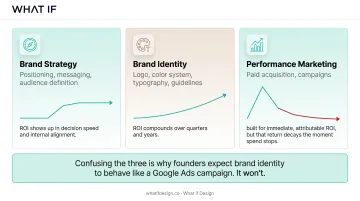
Confusing the three is why founders expect brand identity to behave like a Google Ads campaign. It won't. Holding it to that standard makes it look like a bad investment when it isn't.
2. What ROI should you actually expect from brand identity?
Here's what's actually documented, not estimated.
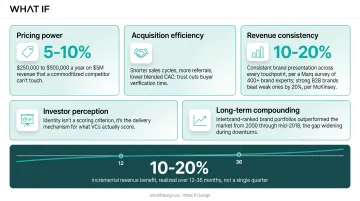
Pricing power. Companies with strong, consistently applied brand identities can sustain premium pricing against functionally similar competitors. For a mid-size company doing $5M in annual revenue, a modest 5-roughly 10% price premium is worth $250,000 to $500,000 a year when buyers trust what they see, revenue a commoditized competitor can't touch.
Acquisition efficiency. Strong brand recognition shortens sales cycles and increases word-of-mouth referrals, both of which lower blended CAC. The mechanism is trust: buyers spend less time verifying you're legitimate when the identity already signals it.
Revenue consistency. A survey of 400+ brand management experts by Marq found companies that present their brand consistently across every touchpoint report 10-20% revenue growth. Separately, McKinsey's analysis of B2B companies found strong B2B brands outperform weak ones by 20%, a benchmark spanning reputation, product, and sales interactions, not identity design alone.
Investor perception. Most VCs will say they fund team, market, and product, not a logo. That's true. But it undersells what identity actually does in a raise: it isn't a scoring criterion; it's the delivery mechanism for the criteria that are scored.
A confusing deck rarely fails because the design is ugly. It fails because the investor can't tell what the team, market, and product actually are.
Long-term compounding. An academic study tracking portfolios built from Interbrand's annual brand rankings found they outperformed the broader market from 2000 through mid-2018, with the gap widening during downturns. That's the difference between "owned" brand equity, which keeps paying you back, and "rented" campaign results, which stop the day you stop spending.
Rule of thumb: if your brand identity is consistently applied, expect roughly a 10-roughly 20% incremental revenue benefit, realized over 12-36 months rather than a single quarter. Anyone promising a faster, cleaner number is selling something.
If your site hasn't kept pace with where the business actually is, we can show you what that's costing you. Get a free strategic audit.
3. When brand identity investment delivers the highest ROI
Timing changes everything with this kind of investment.
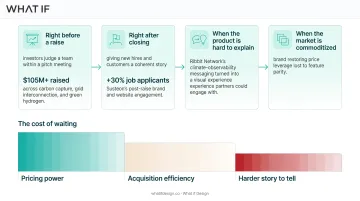
Right before a raise. Fundraising is a storytelling exercise. Investors judge a team and a market within the span of a pitch meeting, and visual clarity carries that judgment across the table.
Akhila Kosaraju, What if Design's co-founder, has worked with founders across carbon capture, grid interconnection, and green hydrogen who have collectively raised more than $105M. That work happens almost entirely in this pre-raise window, when the brief is hardest to write and the stakes are highest.
Right after closing. Post-raise, brand identity does different work: it gives new hires and new customers a coherent story to rally around before either group has built trust the slow way.
Susteon, a carbon capture and utilization company, worked with What if Design on a four-month brand and website engagement. The redesigned site produced a documented 30% increase in job applicants, a hiring-side return, not a sales one, but a real one.
When the product is hard to explain. This is the deep tech and climate tech trigger. If your product brief itself is difficult to write, brand identity has to do work copywriting alone can't: translate a 50kW electrolyzer or a grid-interconnection protocol into something a non-technical partner grasps in thirty seconds.
Ribbit Network, a climate-observability company, needed exactly this. Its executive director noted that What if Design quickly grasped complex greenhouse gas tracking messaging and turned it into a visual experience partners could actually engage with.
When the market is commoditized. If competitors' features look identical on a spec sheet, brand becomes the primary tool for defensibility and premium positioning. Feature parity kills price leverage; distinct identity restores it.
The cost of waiting. Every month a fast-scaling company delays this investment, it compounds in the wrong direction: lost pricing power, inefficient acquisition spend, and a harder story to tell the next time it matters.
4. How to measure and calculate brand identity ROI
You can't manage what you don't baseline. Before any brand refresh, capture where you stand.
Short-term metrics (track within weeks of launch):
- Website conversion rate
- Bounce rate
- Average session duration
- Direct-to-organic traffic ratio
Long-term metrics (track over 12-36 months):
- Customer acquisition cost trend
- Average deal size
- Net Promoter Score
- Employee retention
- Price realized versus list price
The framework itself is simple, even if the discipline to run it isn't:
- Establish a baseline before any brand work starts by capturing the metrics above.
- Re-measure at fixed intervals, at 6, 12, and 24 months, using the same definitions each time.
- Isolate brand-driven change by tracking what else moved in that window (pricing changes, new sales hires, market shifts) so you're not crediting the identity for someone else's win.
CAC is a useful anchor metric here because it's simple to calculate: total marketing and sales spend divided by new customers acquired. If that number trends down while your other go-to-market inputs stay flat, brand consistency is a reasonable factor to credit.
For a direct return figure: Brand ROI = (Value gained − Brand investment) / Brand investment. Value gained can include CAC savings at the same volume, higher average deal size, or better close rates, only after you isolate those lifts from other GTM changes.
The common failure mode is a single read right after launch. Re-measure at 6, 12, and 24 months so brand ROI shows up as a trend, not one post-launch data point.
5. Maximizing your brand ROI: what to invest in
Not every dollar spent on brand identity returns equally. Three things determine whether it compounds or evaporates.
Get the minimum viable scope right. At a minimum, that means:
- Clear positioning and a messaging hierarchy
- A visual identity system (logo, color, typography, iconography) applied consistently
- Documented brand guidelines so the system survives beyond the person who built it
This typically runs a 4-6 week scope, enough to launch coherently without over-investing before you know what's working.
Choose the right delivery model. Founders generally weigh three options:
| Model | Strength | Tradeoff |
|---|---|---|
| In-house hire | Full control, embedded knowledge | High fixed cost, hard to justify pre-Series A |
| Large generalist agency | Broad capability, name recognition | Less sector context, higher overhead, slower iteration |
| Specialized boutique studio | Sector fluency, senior-level attention | Smaller team capacity |
For climate tech and deep tech specifically, sector fluency matters more than it might elsewhere. A studio that already understands carbon capture or grid interconnection doesn't burn your budget on the learning curve.
That is where a specialized boutique earns its keep. What if Design, for example, runs at roughly a third the cost of an in-house senior design hire and covers strategy, identity, website, and product under one roof, so you are not stitching freelancers together mid-fundraise.
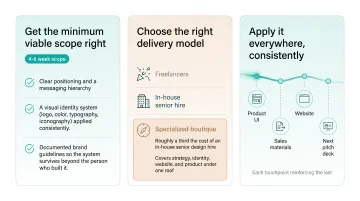
Apply it everywhere, consistently. This is the real ROI lever. A polished identity that lives only in a pitch deck isn't compounding; it's a one-off deliverable. The return comes when the same system shows up in your product UI, sales materials, website, and next pitch deck, each touchpoint reinforcing the last instead of starting from zero.
Clarity here is what turns a defensive conversation into a confident one. Get a free strategic audit.
6. Frequently asked questions
6.1 What is the ROI of branding?
Branding ROI shows up as pricing power, lower acquisition costs, and more consistent revenue, not a single campaign you can trace to a dollar figure. It behaves more like infrastructure than a marketing line item.
6.2 What is a good ROI for brand identity?
A reasonable benchmark is a 10-roughly 20% lift in revenue tied to consistent brand presentation, realized over 12-36 months rather than one quarter. Treat faster, more precise promises with skepticism.
6.3 How long does it take to see ROI from a brand identity investment?
Short-term signals like traffic and conversion can shift within weeks of launch. Full financial ROI, including pricing power and lower customer acquisition cost (CAC), typically takes 12-36 months to compound.
6.4 How much should a startup budget for brand identity?
There is no flat fee, stage and scope set the number. Many early-stage teams fund a focused identity system first, then expand into website and product design as go-to-market and fundraising intensity rise. Tie spend to your marketing budget and the stakes of the next raise, not a generic average.
6.5 Does brand identity ROI apply differently to B2B and climate tech companies?
Yes. For technical B2B and climate tech companies, brand ROI is amplified through investor trust, partnership credibility, and the ability to translate complex science into something non-technical buyers and grant committees can quickly champion.
6.6 What is the difference between brand identity and branding?
Brand identity is the visual and verbal system: logo, color, typography, guidelines. Branding is the broader strategic process of shaping perception, of which identity is just one output.
Related reading: Brand guidelines vs brand identity and ESG storytelling.
Ready to take the next step?
If you're weighing a design partner for climate, deep tech, or hard-to-explain products, Book a strategy call with our founders at What if Design, a no-pressure 25-minute conversation about what you're building and where design can help. You can also View our work to see how we've helped teams like yours, or Get a free strategic Audit of your current brand, website, or product experience.