This decision affects more than aesthetics. It shapes your budget burn rate, how fast you can launch or fundraise, and whether your final brand actually represents a complex product, especially if you're building something technical, like a hydrogen electrolyzer or a carbon capture platform. Design performance isn't a side issue either: McKinsey's five-year study of 300 global companies found that top design performers saw revenue growth 32% higher than their peers, with shareholder returns 56% higher, according to McKinsey's research on design and business value.
So which model fits your company? Let's break it down.
TL;DR: key takeaways
- Boutique firms give you senior talent, tight collaboration, and fast decisions; large firms give bandwidth and multi-market reach.
- Boutique retainers run leaner because you skip account-management layers.
- Niche industries like climate tech, deep tech, and hardware get stronger results from specialists who go deep.
- Choose based on project complexity, timeline pressure, and need for hands-on strategy vs. production volume.
1. Boutique vs large design firm: quick comparison
Here’s how boutique and large design firms compare on the factors founders weigh most.
| Factor | Boutique Design Firm | Large Design Firm |
|---|---|---|
| Cost & Retainer Structure | Leaner monthly retainers, often $3,000: $7,000/month; fewer overhead layers | Higher retainers due to account management, larger teams, and multi-department overhead |
| Team Access | Direct access to senior strategists and founders on every project | Work often routed through account managers before reaching senior creatives |
| Speed & Turnaround | Faster cycles; some studios turn individual requests around in 48 hours | Slower cycles due to internal approval chains and larger team coordination |
| Specialization Depth | Deep focus on one industry or discipline (e.g., climate tech only) | Broad, generalist coverage across many industries |
| Scalability & Capacity | Limited bandwidth for many simultaneous large-scale workstreams | Built for parallel projects across multiple markets at once |
Neither column is wrong. Each model is built for a different job: pick the one that matches your stage, scope, and how you need to work.
2. What is a boutique design firm?
A boutique design firm is a small, independently run studio, usually under 30 people, built around a specific niche and senior talent rather than broad service coverage.
AIGA's profile of RoAndCo, a well-known boutique studio, describes a team of about 13 people delivering branding, e-commerce, and art direction work with founder Roanne Adams directly leading creative direction. That's the model in a nutshell: fewer hands, more direct involvement from the people who actually understand your problem.
For technical or mission-driven companies, this structure solves a real problem. When your product involves grid interconnection, hydrogen electrolysis, or carbon sequestration, the brief itself is hard to write. A senior strategist who learns the underlying science can translate it into brand and product decisions without the message getting watered down as it passes through account layers.
Core operational benefits:
- Faster decision cycles: the person who understands your product is also the person designing for it
- Lower overhead passed on to you, since there's no account-management tier to fund
- More consistent output, because the same people ideate and execute from day one
Boutiques also vary in focus. Some specialize by industry: climate tech, healthtech, fintech. Others specialize by discipline, offering branding only or product design only. A smaller number operate as full-service studios and cover the whole arc from brand strategy through web and product design.
2.1 Where boutique firms fit best
Boutique studios tend to fit early-to-growth stage startups, technical founders raising capital, or teams that need brand and product work fast without hiring in-house. We are a working example of this model: a boutique studio focused exclusively on climate tech, deep tech, and sustainability ventures, working directly with founders across brand, web, and product design.
A few examples from that work:
- HYDGEN, a decentralized hydrogen company, needed brand, web, and UX work that could explain 10 to 100 kW electrolyzers and 99.roughly 97% purity in language investors follow.
- Susteon, a carbon capture and utilization company, worked with the team on brand strategy, visual identity, and a Webflow site; the redesign coincided with a 30% increase in career-page applicants.
- Ribbit Network, an open-source greenhouse gas monitoring network, needed a site and visual identity that made a technical observability platform feel approachable.
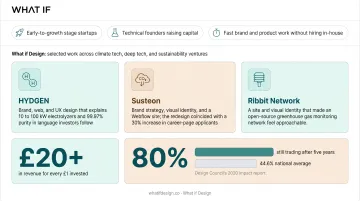
Design Council's 2020 impact report offers a useful data point on why lean, focused design support matters for early-stage companies. Businesses in its programs generated more than £20 in revenue for every £1 invested, and 80% of supported startups were still trading five years later, compared to a 44.6% national average, according to Design Council's own impact findings.
That's not proof a boutique caused those numbers, but it does show that focused design investment correlates with survival and growth for smaller companies.
If your site hasn't kept pace with where the business actually is, we can show you what that's costing you. Get a free strategic audit.
3. What is a large design firm?
A large design firm is an established, multi-department agency (sometimes affiliated with a holding company) with dozens to hundreds of employees spread across account management, strategy, creative, and production. That structure is built to run many workstreams simultaneously across markets, languages, and compliance requirements.
For large-scale organizations, that infrastructure matters. Enterprise rebrands need legal review layers. Global campaigns need consistent execution across a dozen offices. A large agency's bandwidth becomes an asset rather than a bottleneck.
Core operational benefits:
- Higher capacity for parallel projects across regions or product lines
- Established QA processes built for large-scale rollouts
- Dedicated specialist teams for each discipline, from packaging to digital to compliance
Some large firms operate independently. Others belong to holding-company networks with offices spanning dozens of countries. That structure matters when a rebrand needs to land consistently everywhere at once.
3.1 Where large firms fit best
This model suits enterprise rebrands, multi-country campaign rollouts, or organizations that need many deliverables produced in parallel. Typical clients include consumer packaged goods, global retail, and enterprise B2B companies coordinating campaigns across several markets at once.
Interbrand's work with Allianz shows what this model can handle. Allianz needed to unify its commercial businesses under one identity, and Interbrand (operating in 75 countries through 14 global hubs) helped launch Allianz Commercial globally by 2023 with a consistent name and identity system.
Pentagram's rebrand of Global Switch is a similar case. The data-center operator has more than 500 staff across seven countries; a new logo, color system, and typography rolled out across 12 facilities in Europe and Asia, with implementation templates built to simplify multi-office adoption.
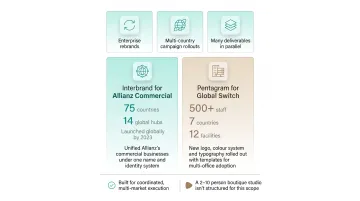
That kind of coordinated, multi-market execution is what large firms are built for. A two- or ten-person boutique studio isn't structured to handle the same scope at once.
4. Boutique vs large design firm: which is right for you?
The right choice comes down to five questions:
- How technical or hard-to-brief is your product? Complex science needs a partner who learns it first.
- How urgent is your timeline? Boutiques tend to move faster with fewer approval layers.
- What's your budget structure? Lean retainers versus larger, multi-tier engagements.
- Do you need senior hands-on attention or raw production volume? Boutiques put senior people on the work; large firms win on throughput.
- How niche is your industry? The narrower the niche, the more a specialist outperforms a generalist.
Choose a boutique firm if:
- Your product or science is complex and hard to explain
- You need senior designers directly involved
- You're moving fast on a lean budget
Choose a large firm if:
- You need simultaneous execution across many markets or channels
- You're navigating compliance-heavy, enterprise-scale requirements
4.1 A real-world example: translating deep tech into a fundable brand
Susteon, a carbon capture and hydrogen technology company, faced a common deep-tech challenge: how do you turn a highly technical CO₂-management process into a brand story investors and partners can connect with?
They brought in What if Design for a four-month engagement covering brand strategy, visual identity, and a full website redesign on Webflow.
Work started with a strategy workshop to pull in stakeholder perspectives before any design began. That step mattered: much of Susteon's value lives in technical detail that's easy to over-explain and easy to under-sell.
Sudarshan Gupta, COO of Susteon, Sudarshan Gupta, described the team as "nimble, thoughtful and flexible," adding that they "accurately translated our vision."
Takeaway: When the hardest part of your project is making a complex product understandable, specialization tends to beat scale. A large agency can execute a hundred deliverables at once. A boutique that already speaks your technical language can get the right deliverable done faster.
If you're a climate tech or deep-tech founder still weighing this decision, book a strategy call with What if Design. We'll talk through your brand, web, or product needs. No sales pitch, just a clear read on what the project actually requires.
5. Conclusion
Neither model is universally better. A boutique studio and a large agency solve different problems. The right pick depends on whether you need deep, senior-led specialization or broad, multi-market production capacity. A hydrogen startup writing its first fundable pitch deck has different needs than a global retailer rolling out packaging in 40 countries.
For technical and mission-driven founders specifically, boutique firms often shorten the distance between a complex idea and work that actually closes funding, partnerships, and adoption. Large agencies still win on scale and multi-market production. Choose the partner built for the problem you have, not the one with the biggest office.
Clarity here is what turns a defensive conversation into a confident one. Get a free strategic audit.
6. Frequently asked questions
6.1 What is the difference between a boutique and a large design firm?
Boutique firms are small, senior-led studios that stay closely involved in every project, while large firms are multi-department agencies with account managers, dedicated specialist teams, and broader service coverage. The tradeoff is personal attention versus bandwidth.
6.2 Is a boutique design agency cheaper than a large firm?
Boutiques typically carry leaner overhead since there's no account-management layer to fund, which often means lower retainers. True cost still depends on project scope, deliverables, and how much production volume you actually need.
6.3 Can a boutique design firm handle enterprise-level projects?
Many boutiques handle strategy- and creative-led enterprise work well, since that's where senior expertise matters most. Very large parallel production runs across many markets, however, can exceed a small team's bandwidth.
6.4 How do I know if my startup needs a boutique or large design firm?
Look at product complexity, timeline urgency, and whether you need senior-level involvement more than sheer output volume. Technical, hard-to-brief products usually benefit from a specialist boutique.
6.5 Do boutique design firms offer full-service capabilities?
Many boutiques cover branding, website design, and product design despite a small headcount. Confirm exact service lines before you engage, since offerings vary studio to studio.
6.6 What are the risks of working with a large design firm?
Larger firms can mean slower turnaround due to approval chains, less direct access to senior creatives, and higher overhead costs baked into retainers. These tradeoffs matter most when your timeline is tight or your product is highly technical.
Related reading: 10 Best SaaS UX Design Agencies For Product Growth In 2026 and Discover the top UI/UX design agencies in Bangalore.
Ready to take the next step?
If you're weighing a design partner for climate, deep tech, or hard-to-explain products, Book a strategy call with our founders at What if Design, a no-pressure 25-minute conversation about what you're building and where design can help. You can also View our work to see how we've helped teams like yours, or Get a free strategic Audit of your current brand, website, or product experience.