Nobody planned this. There's simply no single source of truth everyone pulls from.
This is more common than most teams admit. According to a survey of 400+ brand-management professionals reported by Marq, 85% of organizations have brand guidelines, but only 30% consistently enforce them. A PDF buried in a shared drive isn't the same thing as a usable toolkit.
This guide breaks down exactly what belongs in a brand toolkit, why it matters more for technical and science-driven companies than most, and how to build one step-by-step, even if you're starting from scratch.
TL;DR: key takeaways
- A brand toolkit delivers ready-to-use files and clear rules teams can apply, not a mood board or style description alone.
- Consistent branding drives 3 to 4x stronger visibility and about 23% higher self-reported revenue.
- Climate and deep tech toolkits need a "translation layer" so non-experts grasp the product fast.
- Strategy comes before design: mission, positioning, and audience insight must exist before assets do.
- Toolkits need governance: an owner, a review cadence, and one accessible home.
1. A brand toolkit, in one paragraph
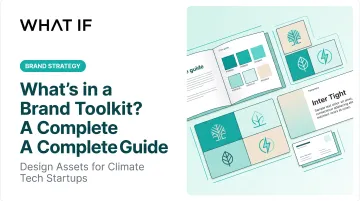
A brand toolkit is the ready-to-use library of approved assets, paired with the rules for applying them correctly. Think of it as the brand playbook: a designer, a sales rep drafting a proposal, or a freelancer building a landing page should all be able to open it and produce on-brand work without asking a single follow-up question.
1.1 Toolkit vs. guidelines: the meal kit difference
Brand guidelines and a brand toolkit are used interchangeably, but they solve different problems.
- Brand guidelines are the recipe: they explain how the brand should look and sound, covering color meaning, tone-of-voice principles, and logo philosophy.
- A brand toolkit is the meal kit: pre-measured ingredients plus the recipe: logo files, color swatches, templates, and boilerplate copy ready to use.
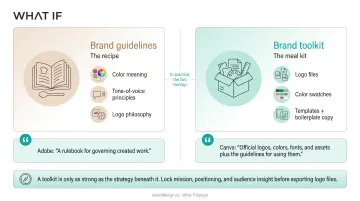
Adobe describes a style guide as a rulebook for governing created work. Canva defines its Brand Kit as official logos, colors, fonts, and assets plus the guidelines for using them.
In practice, the two overlap. The strongest toolkits bundle rules and files in one place, instead of splitting them across a PDF and a scattered folder of exports.
A toolkit is only as strong as the strategy underneath it. Lock mission, positioning, and audience insight before anyone exports logo files. Skip that step, and you get a polished kit that doesn't reflect what the company does or who it serves.
2. Why a brand toolkit actually moves the needle
Brand presence used to mean a logo, a website, and maybe a brochure. Now it's scattered across social channels, pitch decks, product UI, support tickets, and investor updates. Inconsistency in any one of these chips away at recognition and trust.
The numbers back this up. A Demand Metric and Lucidpress study of 234 qualified respondents found that companies presenting their brand consistently were 3 to 4 times more likely to report excellent brand visibility.
Among organizations still struggling with consistency, respondents estimated an average 23% revenue increase if they fixed it. That figure is self-reported, not a guaranteed outcome, but a meaningful signal.
2.1 The stakes are higher for climate tech and deep tech
For deep tech and climate tech founders, this problem compounds. A carbon capture startup or a green hydrogen company has to explain genuinely complex science clearly and consistently to investors doing diligence, regulators, enterprise partners, and customers who've never heard the term "electrolyzer."
Every touchpoint needs to say the same thing, in the same voice, without diluting the technical accuracy.
What if Design, a San Francisco and Bangalore-based studio, specializes in translating complex science into visual and verbal systems that hold together across fundraising decks, websites, and product interfaces.
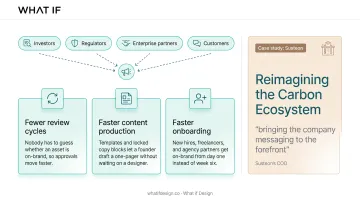
Its work with Susteon, a carbon capture and utilization company, shows how this plays out. The team reframed a highly technical brand around "Reimagining the Carbon Ecosystem," a line that carried through the website, event collateral, and investor decks. Sudarshan Gupta, COO of Susteon credited the process with bringing "the company messaging to the forefront."
A toolkit isn't a design nicety in this context. It's operational infrastructure:
- Fewer review cycles: nobody has to guess whether an asset is on-brand, so approvals move faster.
- Faster content production: templates and locked copy blocks let a founder draft a one-pager without waiting on a designer.
- Faster onboarding: new hires, freelancers, and agency partners get on-brand from day one instead of week six.
That matters even more when a small team is stretching across fundraising, hiring, and product launches at once, which is the default state for most seed and Series A climate tech companies.
Our take (from actually doing this)
Reading twenty articles on brand toolkit will give you the same five bullet points repeated in different fonts. Here's what actually moves the needle when we're inside a real engagement:
- The best decision is rarely the option with the lowest sticker price, it's the one that costs the least to change when your product or funding position shifts in six months.
- Founders consistently underweight the communication tax: how much of your week you'll spend re-explaining what you're building. The right partner should reduce that tax, not add to it.
- The only reliable way to de-risk this decision is to look at what a partner has actually shipped for teams like yours, not what they say they can do.
That's why our own recommendations lean toward specialists over generalists for climate and deep-tech work. If you want to pressure-test your specific situation, book a strategy call, 25 minutes, no pitch, and we'll be direct about whether we're the right fit.
💡 Working through this decision right now? If you're a climate-tech or deep-tech founder weighing this trade-off, Book a strategy call with our team, 25 minutes, no pitch, and we'll pressure-test your specific situation.
3. What's inside a complete brand toolkit: the core components
A complete toolkit goes well beyond a logo file. It should let anyone on the team, or any outside partner, answer "how do we look and sound" without a single follow-up question. That means covering four areas: visual identity, voice, application templates, and governance.
3.1 Visual identity assets
This is the foundation most people picture, but a real system goes deeper than a logo:
- Logo suite: primary, secondary, and monochrome versions, with clear-space and minimum-size rules
- Color codes: HEX, RGB, CMYK, and Pantone values, with usage context for each shade
- Typography hierarchy: display, heading, and body fonts, plus fallbacks for email and slides
- Imagery and iconography: approved photo style, icon treatments, and side-by-side dos and don'ts
What if Design's climate tech toolkits document color specs for print and digital separately, including a WCAG-AA-compliant palette. Accessibility contrast matters when regulators and non-technical investors are reading dense material.
See how we have approached this in practice: ESG storytelling.
3.2 Voice & messaging guidelines
Looking consistent isn't enough if the brand sounds different in every channel. This layer covers tone-of-voice principles, core messaging (tagline, value proposition, elevator pitch), and sample copy for different channels, so a support agent and a sales rep sound like the same company.
For technical or science-based brands, add a translation layer: pre-approved ways to explain complex concepts simply for non-expert audiences.
Susteon needed exactly this. Its carbon-capture tech was accurate but dense, so What if Design built a broader narrative a generalist investor could grasp in one read, without losing the scientific substance.
3.3 Application templates & usage rules
Rules mean little without ready-to-use files. This section should include:
- Pitch deck and one-pager templates for fundraising and partner outreach
- Social post and email signature templates for day-to-day consistency
- Explicit dos and don'ts for logo and messaging misuse (stretched logos, off-brand colors)
What if Design typically packages this as a digital asset toolkit with reusable templates, including pitch deck templates built specifically for climate tech fundraising conversations.
3.4 Brand governance & access
Someone has to own the toolkit, or it decays within a couple of quarters. Define:
- Who approves changes: one person or a small committee, not "whoever's free."
- Review cadence: how often the toolkit gets audited against real usage.
- Where it lives: one accessible home, not five folders spread across three drives.
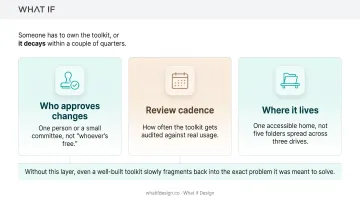
Without this layer, even a well-built toolkit slowly fragments back into the exact problem it was meant to solve.
4. How to build a brand toolkit from scratch
Building a toolkit is a strategy-first process, not a visuals-first one. Skipping straight to logo exploration is exactly why so many toolkits end up looking polished but disconnected from what the company actually does.
4.1 Lock in brand strategy before design
Before anyone opens a design tool, define mission, vision, positioning, and audience insight. Who are you actually talking to, and what do they need to believe about you?
Design partners who take the time to learn a founder's market and technology tend to produce toolkits that hold up under scrutiny. At What if Design, work with climate tech founders starts with a strategy workshop that pulls in stakeholder input before any design begins. The LabStart rebrand followed this path: workshop findings became a creative brief that shaped the logo and website structure.
4.2 Audit and compile what already exists
Gather every logo file, deck, one-pager, and social template currently in use, including the outdated ones nobody remembers making. This step surfaces the inconsistencies you're trying to fix:
- Which logo version is actually being used on the website vs. the deck?
- How many different shades of the "brand color" exist across channels?
- Which old taglines are still floating around in old collateral?
You can't fix what you haven't inventoried.
4.3 Build master assets and document the rules
Now create the final, locked versions: logo files in every format needed, a locked color palette with exact codes, and a defined type system. Pair every rule with a visual example. "Don't stretch the logo" means nothing without a picture showing what stretched actually looks like.
This is also where technical brands document messaging hierarchy and voice, so the translation layer gets written down instead of reinvented every time someone drafts a deck.
4.4 Stress-test, launch, and train the team
Before calling it done, test whether someone outside the design team, say a marketing intern, can produce on-brand work using only the toolkit, unaided. If they can't, the toolkit isn't finished. It's just documented.
Once it passes that test:
- Host a launch or training session so the whole team sees where everything lives and how to use it.
- Set a review cadence upfront, so updates happen on schedule rather than after something's already gone off-brand.
- Assign an owner who fields questions and keeps the toolkit current.
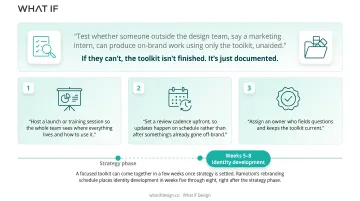
A focused toolkit can come together in a few weeks once strategy is settled. Ramotion's rebranding schedule places identity development in weeks five through eight, right after the strategy phase. That window covers the logo system, visual toolkit, and guidelines.
5. What we've learned about to manage your toolkit in practice
The right platform depends on team size and how often assets change.
- Small teams: Google Drive or Notion work fine for file storage and basic sharing, especially when one team owns the toolkit.
- Larger or multi-team organizations: Dedicated platforms like Figma, Frontify, or Bynder add version control, metadata, and granular permissions once freelancers, agencies, and multiple departments share the same library.
You do not always need enterprise software. What if Design's client handoff runs through Figma for design files, Loom for walkthrough videos, and Linear for tracking requests. That lightweight stack still gives clients a permanent, organized reference instead of a one-time export.
5.1 Keep it current, not just complete
A toolkit built once and never revisited becomes exactly the scattered-folder problem it was meant to solve.
- Review quarterly or semi-annually: audit how guidelines are actually being applied across real channels, not just how they look on paper.
- Update before major launches, not after inconsistencies have already shipped.
- Build toolkit training into onboarding, so new hires, freelancers, and partners never have to guess how the brand should look or sound.
Fast-moving brands, those shipping new decks, campaigns, or product screens every month, should lean toward the tighter quarterly cadence rather than waiting a full year.
A site that reflects the company you have actually become is the cheapest credibility you can buy, and it puts you back in control of the first impression. Get a free strategic audit.
6. Frequently asked questions
6.1 What should a brand toolkit include at minimum?
Different frameworks cite five to seven pillars covering purpose, positioning, personality, perception, and promotion. There's no single agreed-upon list, but a brand toolkit directly supports consistency and positioning by giving teams the tools to express them the same way everywhere.
6.2 What's the difference between a brand toolkit and brand guidelines?
Guidelines are the rules for how the brand should look and sound. A toolkit hands over the ready-to-use assets: logos, templates, and copy blocks, needed to execute those rules immediately.
6.3 How long does it take to build a brand toolkit?
It depends on brand maturity, but a focused toolkit typically comes together in a few weeks once strategy is locked. Agencies often schedule identity and toolkit development right after the strategy phase wraps.
6.4 Who should have access to the brand toolkit?
Marketing, sales, product, and support teams all need access, along with external partners like agencies and freelancers. Permission-based access (view vs. edit) protects the master files while still letting everyone use them.
6.5 Do early-stage startups really need a brand toolkit, or can it wait?
Even a lightweight version early on prevents costly rework later. This matters most for startups raising funding or scaling fast, where inconsistent decks and websites can undercut credibility with investors.
6.6 What tools are best for storing and sharing a brand toolkit?
Notion or Google Drive work well for small teams needing basic storage and sharing. Larger, multi-team organizations typically need Figma, Frontify, or Bynder for version control and permissions.
Ready to take the next step?
If you're weighing a design partner for climate, deep tech, or hard-to-explain products, Book a strategy call with our founders at What if Design, a no-pressure 25-minute conversation about what you're building and where design can help. You can also View our work to see how we've helped teams like yours, or Get a free strategic Audit of your current brand, website, or product experience.