Many battery companies still reach for the same lightning bolt and glowing blue gradient. Buyers then struggle to tell one supplier from the next.
A strong battery brand turns technical value into a clear, credible, memorable promise. This article covers what makes battery branding work, the main visual directions in use, current trends (with an India lens), and a practical framework for building an identity that scales.
Key Takeaways
- Strong battery brands tie technical performance to an outcome such as reliability, safety, or a circular energy system.
- The identity must work across logos, websites, dashboards, datasheets, and investor decks.
- Design is moving past the lightning bolt toward modular, data-informed, circular visual languages.
- Test small sizes, accessibility, and industrial use before launch.
What Makes Battery Branding Effective?
Start with the market problem, not the battery icon
Define the exact category first. A cell manufacturer, a stationary-storage company, a BMS platform, and a recycling venture each need a different story.
Then map what each audience must believe before acting:
- Vehicle makers and fleet operators: dependable performance and supply
- Utilities and procurement teams: safety, standards, and lifecycle cost
- Investors: a credible route to scale
- Engineers: proof they can verify
In India, buyer concerns are specific. A Bain survey found that battery reliability worried 52% of Indian BEV skeptics, ahead of price (32%) and range (31%). Messaging that addresses reliability directly beats generic sustainability language.
Translate technical advantage into a brand promise
Convert energy density, cycle life, charging performance, and safety systems into outcomes people grasp. Back every performance claim with company or third-party test evidence.
Build a messaging hierarchy with two layers: a simple category explanation, then deeper technical proof. That lets one brand work in a pitch deck, a website headline, a dashboard, and an engineering document.
Evidence-led content matters here. In the 2025 Edelman-LinkedIn study, 65% of decision-makers said they trust thought leadership more than marketing materials and product sheets when judging supplier capability.

Build trust into the visual and verbal identity
Precision, durability, transparency, and long-term thinking can all be signalled through typography, grid, colour, and language. Cite only certifications that apply to your product. The scope of each standard matters:
| Standard | What it covers |
|---|---|
| BIS IS 17387:2020 | Safety and performance of battery management systems |
| IEC 62133-2 / IS 16046 (Part 2) | Portable sealed secondary cells; not a traction-pack certification |
| IEC 62619 / IS 16805 | Industrial lithium cells and batteries, including stationary |
| UL 9540 / 9540A | Energy storage systems; thermal-runaway fire-propagation test |
The battery symbol itself is context-dependent. An outline with terminals suits an interface but is often too generic as a corporate mark.
Design a system that scales beyond the logo
Evaluate the full kit:
- Symbol, typography, colour, and imagery
- Motion, iconography, and data visualisation
- Tone of voice and layout rules
Then test it on website headers, mobile screens, equipment labels, packaging, trade-show signage, technical PDFs, investor decks, and social avatars.
Check accessibility too. WCAG 2.2 requires a contrast ratio of at least 4.5:1 for normal text and 3:1 for large text. Logo text is exempt, but your interface and documents are not.

Top Battery Branding Designs and Visual Directions
How to judge whether a battery brand is strong
Judge every brand against the same criteria:
- Strategic fit
- Distinctiveness
- Technical credibility
- Emotional relevance
- Scalability
- Consistency across touchpoints
The cases below are agency-documented design choices, not proof of commercial success or an objective ranking.
Minimal, engineered identities
Enerpoly, a zinc-ion battery developer, paired Scandinavian minimalism with a bold, vibrant palette. Most Studios positioned it around access to clean energy rather than as "another battery company."
Minimalism clarifies when it is anchored by a strong idea. Without one, it makes a company look like every other industrial technology brand. The vibrant palette is what keeps Enerpoly from reading as cold.
Energy-flow and modular visual systems
Homevolt, a residential battery, uses a modular Morse-code-style pattern inspired by energy flow, plus LED-inspired colour states. Charging and discharging become part of the identity itself.
Exide shows the portfolio version. Its redesign applied a unified product design language across two-wheeler, car, tractor, and truck batteries. A modular system lets a range expand while the core mark stays recognisable.
NODI, a plug-in home battery, kept its wordmark and built the identity around the product. The pitch is a battery with no routine for the user to learn.
Circular, material-led, and climate-focused identities
- Lithion (battery recycling): 3D visuals and photography of recovered critical materials express material recovery.
- Cactos (storage from upcycled EV batteries): a hexagon taken from the unit's air-filter panel, meant to stand apart in a "techy and conventional" category.
Circular storytelling needs evidence behind it. Recycled-content figures, collection rates, and lifecycle scope should be ready before the imagery makes the promise.
Human-centred EV and consumer-facing brands
Battery Smart, India's battery-swapping network, was framed around "swapping anxiety with opportunity." That speaks directly to a user concern.
Consumer and industrial brands signal strength differently:
- Consumer brands: benefit-led language, expressive colour, and onboarding
- Industrial suppliers: standards, test data, and deployment evidence
Uttam Electric puts the brand mark, capacity, warranty badge, and key claims on the product sticker, so the battery explains itself at the point of use.
Battery Branding Trends to Watch
From the cell to the energy ecosystem
Brands now explain how batteries connect vehicles, homes, grids, fleets, software, and renewable generation. Tesla says its Megapack software controls, monitors, and optimises the system, with over-the-air updates. The brand story sits at system level.
Product experience and data-driven branding
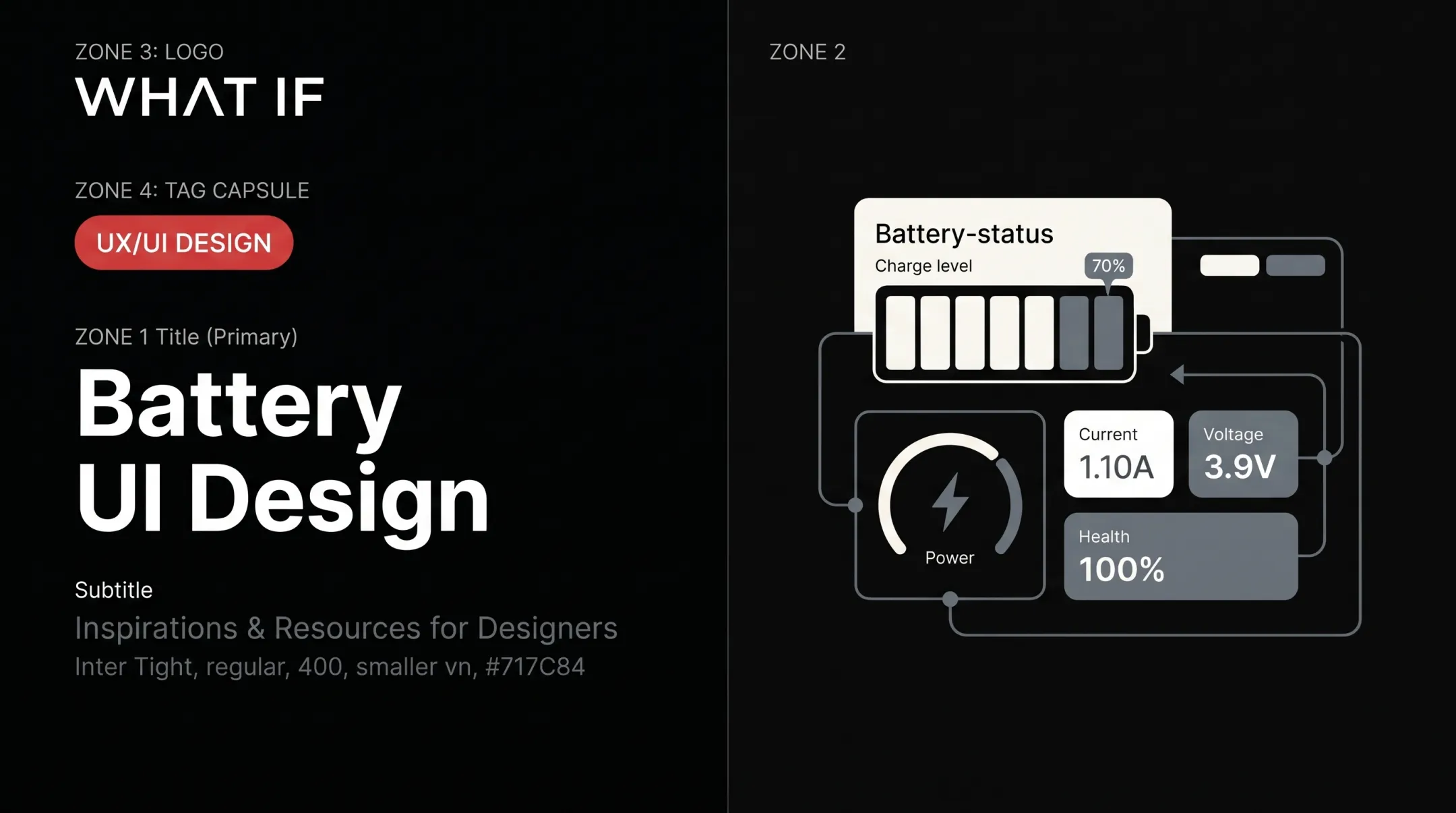
Dashboards, charge-state indicators, alerts, and performance reports now shape brand perception. What if Design's Batteryze project, a battery health dashboard for a circular EV battery economy, shows material value and health statistics in an intuitive interface.
Share one design language between marketing and product UX. Colour meanings, terminology, and interaction patterns should match everywhere.
Sustainability claims becoming specific
Broad "green" language is giving way to traceability, lifecycle transparency, and end-of-life planning. India's 2024 CCPA greenwashing guidelines require accessible, verifiable evidence and clarity on what a claim applies to.
The Battery Waste Management Rules, 2022 assign EPR obligations to producers. The EU Battery Regulation adds QR-code battery passports from February 2027.
To avoid greenwashing:
- State whether a claim covers the product, process, or packaging
- Keep evidence accessible
- Attach categories and dates to compliance claims
Flexible motion and responsive identities
Motion can show charge, flow, or network activity, provided it stays legible and restrained. Responsive identities adapt across product lines, screen sizes, and languages. Keep one recognisable core.
Local relevance in India
NITI Aayog reports India's EV sales of 2.08 million in 2024, and says batteries make up almost 40% of an EV's capital cost. Price, reliability, climate, and charging access all shape trust.
Regional-language needs are real, so test battery messaging with your own audience rather than assuming one approach fits every market.
A Practical Battery Brand Identity Framework
Discover the strategic foundation
Start before any visuals:
- Run stakeholder interviews and map audiences.
- Scan competitors and category language.
- Review the technical proof you actually have.
- Define positioning, promise, personality, and reasons to believe.
- Set boundaries on claims you cannot yet substantiate.
Build the identity toolkit and touchpoint system
Go well beyond the logo. Core deliverables include:
- Symbol rules and typography
- An accessible colour palette
- Imagery direction and iconography
- Motion principles and data-visualisation rules
- Tone of voice and usage examples
Map them to your real journey: fundraising, partnerships, procurement, onboarding, engineering communication, support, and sales.
Validate, launch, and maintain
Test with technical and non-technical audiences on small screens, in industrial settings, in print, and in multilingual layouts. Define measures up front, such as comprehension and trust.
Running this end to end is easier with a partner already working in the category. What if Design is a remote-first creative partner for climate-tech and battery companies, covering brand, website, and product design with senior-level strategic involvement.
Common Battery Branding Mistakes to Avoid
Relying on generic electricity symbols
Lightning bolts, glowing blue gradients, battery outlines, leaves, and circuit patterns blur companies together. Use them only when they carry a specific strategic meaning.
Making claims the identity cannot support
Words like clean, safe, green, and zero-emission need a defined scope and evidence. Have technical, legal, and sustainability stakeholders review them. Do not cite a portable-cell standard as proof for a traction pack.
Designing a logo instead of a system
A handsome mark still fails when it is:
- Unreadable on equipment
- Inconsistent in software
- Inaccessible in colour
- Unsupported by messaging guidelines
Frequently Asked Questions
What is the symbol of a battery?
Diagrams, devices, and interfaces use a cell or battery outline with terminals, and charging contexts add indicators. IEC 60417 lists "Battery, general" symbols. No single universal symbol exists for a corporate battery brand.
What makes a good battery brand?
Clear positioning, a credible technical promise, distinctive visual language, and relevance to the audience. It stays consistent across physical and digital touchpoints.
How can a battery company differentiate its branding?
Own a specific market position, back benefits with evidence, build a recognisable design system, and hold a point of view on the future of energy.
What should a battery brand identity include?
Logo and symbol, typography, colour, imagery, messaging, data visualisation, product UX guidance, and usage rules.
Should a battery brand use a lightning bolt or battery icon?
Familiar symbols aid recognition but quickly turn generic. Test any symbol against your category, audience, and intended applications.