While most EV startups spend their marketing budgets explaining the technology, Slate is building a consumer brand that people actually want to belong to. Lee Ford, the brand strategist behind the company's positioning, explains how.
TLDR
- $1.4 billion raised, 180,000 reservations, and a $24,950 truck heading to production Meet Slate Auto and the brand strategy behind its positioning
- The $50,000 problem hiding inside every new car
How Slate identified the industry's blind spot and built a founding thesis around it - Why Slate stopped trying to sell you on electric vehicles
The strategic decision to skip EV education entirely and what it unlocked - Whatever Big Auto does, do the opposite
Positioning through inversion, real-world stunts, and why engagement metrics are misleading - How to build a community before your first delivery
Radical transparency as a trust engine when you have no track record - The technology has an expiration date, but your brand doesn't
Why value proposition outlasts innovation and what Slate is betting on - Summary: What mass-market climate tech can take from the Slate playbook
$1.4 billion raised, 180,000 reservations, and a $24,950 truck heading to production
Founded in 2022, Slate Auto revealed itself to the public in April 2025, and what it revealed wasn't just a vehicle. It was a fundamentally different opinion about what an automotive brand should be.
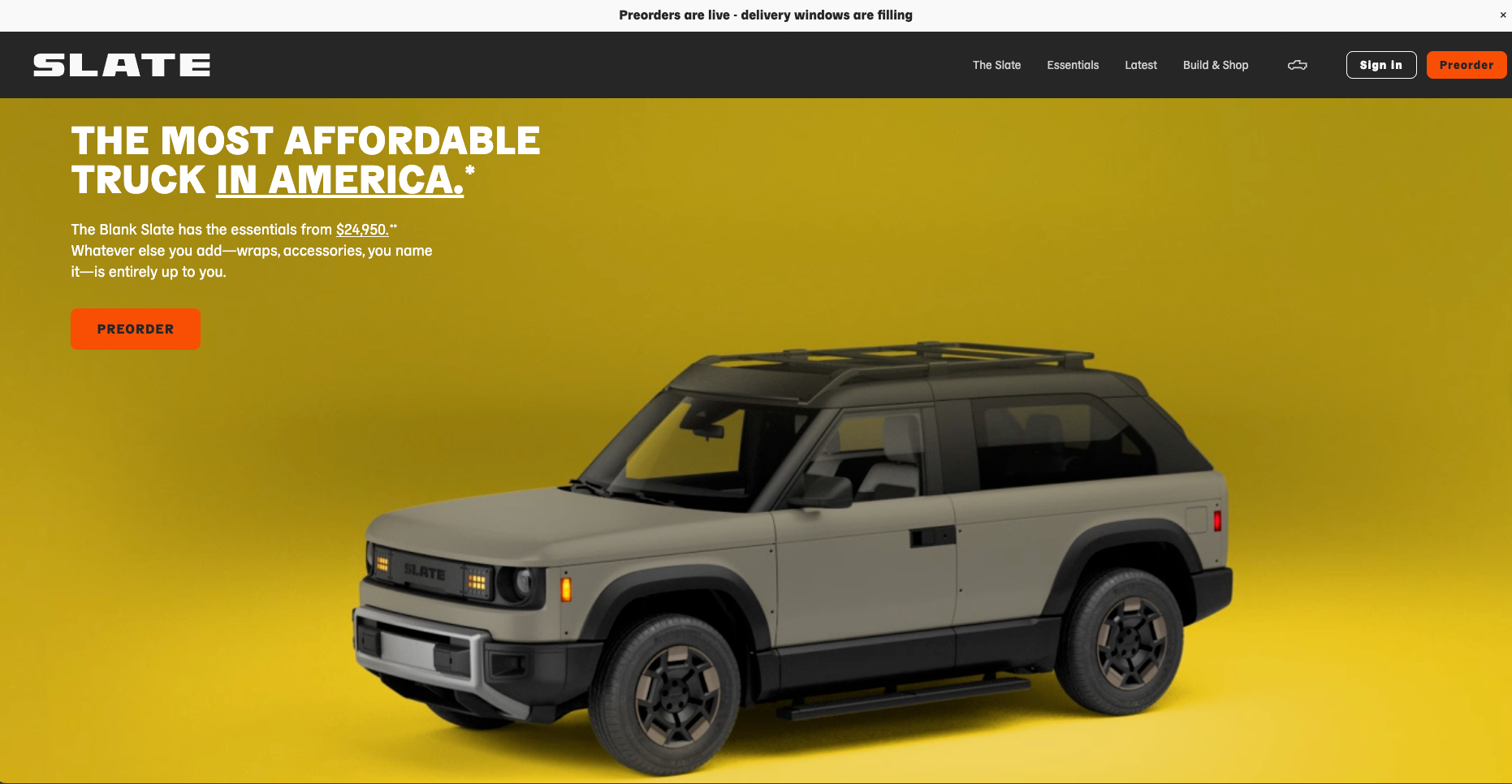
The company has raised roughly $1.4 billion to date and attracted more than 180,000 refundable reservations for its flagship vehicle: a stripped-down, radically customizable electric pickup truck. In June 2026 Slate confirmed a starting price of $24,950, or $26,400 with the mandatory destination fee, one of the most affordable new EVs and trucks on sale in the US.
The factory, a 1.4-million-square-foot former printing plant in Warsaw, Indiana, is being retooled for production, with first deliveries expected by the end of 2026.
Even before its first delivery, Slate has cultivated an organic community of advocates who answer questions on Reddit and brand forums without being asked.
Lee Ford is the brand strategist behind that community, and behind the positioning decisions that made it possible. She joined Slate about a year and a half ago after spending almost 9 years at Wieden + Kennedy NY developing brands that often required habit changes from people, like Lyft and Ford Motor Company's EV line.
In this article, we walk through Slate's approach to brand strategy, consumer positioning, pre-launch community building, and creative execution, from why the team refuses to educate consumers on electric vehicles to how they invert Big Auto's playbook on every brief, and what Ford has learned about building trust and meaning before your first product ever reaches a customer.
The $50,000 problem hiding inside every new car
As Ford points out, the average price of a new car in the United States is now around $50,000, covering both electric and ICE vehicles, and she sees it as a symptom of an industry-wide problem that has been compounding for years.
Cars have gradually absorbed layers of technology that have nothing to do with driving, from entertainment screens and subscription software to autonomous systems that are still years from working reliably, and the consumer is the one absorbing the cost.
"There's a lot of bloat in the industry", Ford says.
"Cars today come with Netflix, massage seats, and all kinds of tech-forward features. The question was: can we get back to something simpler, something that just works really well as a vehicle?"
- Lee Ford, Brand Strategist, Slate Auto
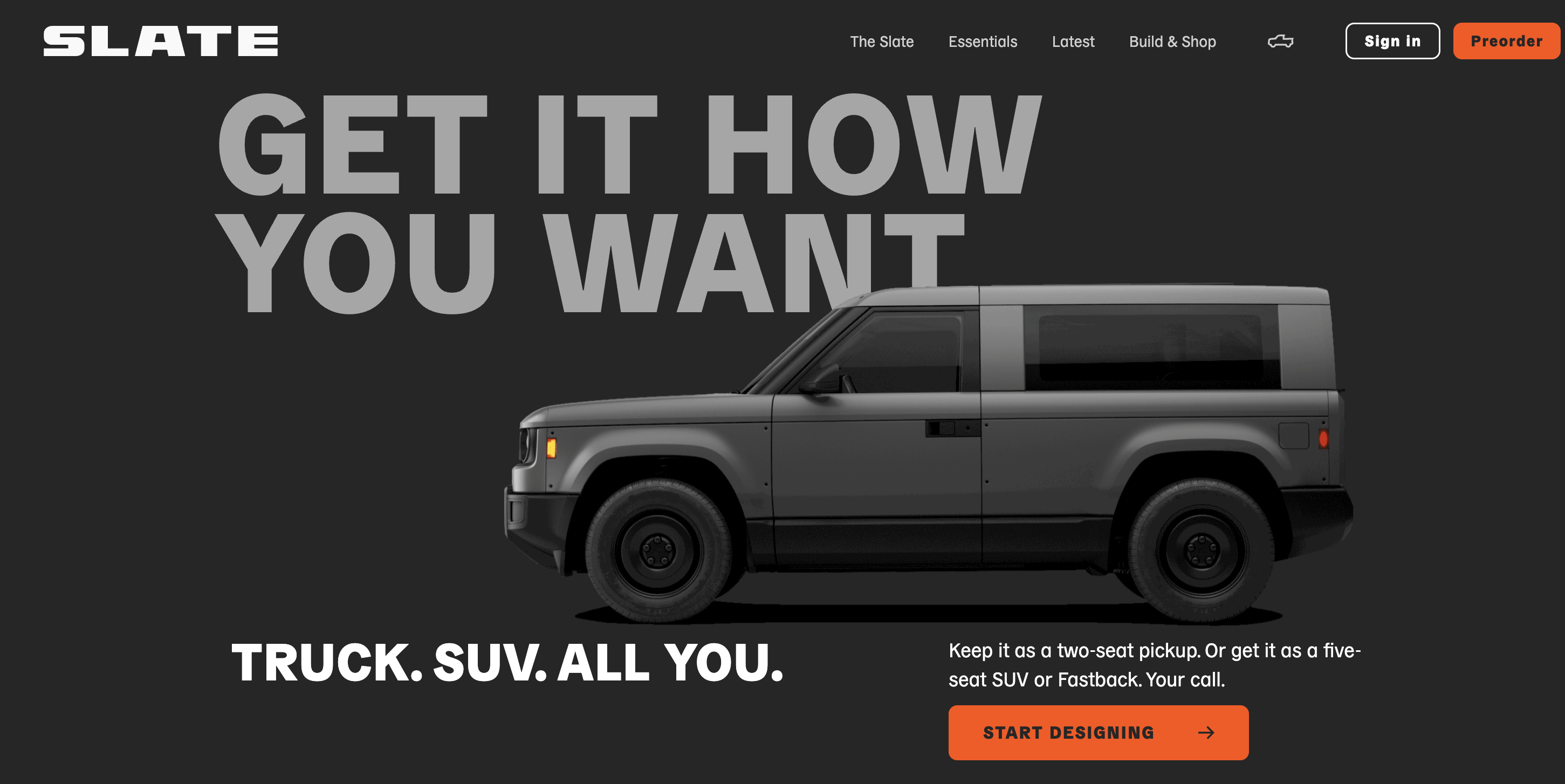
Slate's founding thesis is a direct response to that bloat. The vehicle is built on a single-model platform that comes off the production line in a base configuration, and from there, the customer decides what it becomes:
- The exterior can be any color through partial or full wraps
- The interior accessories are swappable
- The truck converts into an SUV configuration
- Owners can actually work on and modify the vehicle themselves, which is something most EVs actively prevent
Ford doesn't lean on a fixed buyer persona, in part because Slate is still pre-launch and, by design, is built for many kinds of owners. But the archetype the team keeps returning to reveals how they think about the brand.

"We talk a lot about Slate being for a curatorial type of person—people who don't just consume the world as it is—they see what it could become and want to create it".
- Lee Ford, Brand Strategist, Slate Auto
When you buy a Slate, you're buying into your own taste and your own use case. The vehicle is a canvas, and the brand is the permission to use it however you want.
Why Slate stopped trying to sell you on electric vehicles
The most counterintuitive decision Slate has made is the one that defines everything else about its marketing.
The company has chosen to deprioritize EV education almost entirely.
Ford's reasoning is practical. Tesla, Ford, and the other early movers have already absorbed the cost of introducing electric vehicles to the mainstream. That ground has been covered on someone else's budget, and Slate has no interest in covering it again.
"So many other brands have done the heavy lifting of introducing electric vehicles into the market", Ford says.
The distinction she draws is one that most companies in the space fail to make. There is a meaningful difference between convincing someone to buy an EV and convincing someone to buy a Slate, and when you spend your energy on the former, you solve a category-level problem without building any equity that accrues specifically to your company.
Ford frames this as a deliberate choice. She wants consumers excited about the product, and she's willing to let the broader EV education happen in the background, driven by the brands that feel responsible for it. Her bet is that genuine excitement will carry people through the unfamiliar parts of EV ownership on its own.
"People are more willing to try new technology when they see meaningful possibilities, not just technical explanations".
- Lee Ford, Brand Strategist, Slate Auto
The phrase she and the Slate team use internally captures the philosophy: "Being an electric vehicle is the least interesting thing about us".
Whatever Big Auto does, do the opposite
Slate's positioning philosophy translates into a creative filter that Ford describes as simple. Look at what the legacy automakers are doing, and invert it.
When a traditional OEM runs a cinematic hero shot of a vehicle ascending a mountain road, Slate shows the messy, real, lived-in version. When competitors lead their campaigns with autonomous driving and AI-powered cabin technology, Slate publishes content about how to open a door with a handle.
"If a traditional OEM is showing a really polished, beautiful photo of their vehicle that feels superhuman and tech forward, we're showing the messy version", Ford says. "They're talking about autonomous and AI technology, we're explaining how to open a door with a handle. We're trying to do everything that's anti-Big Auto".
- Lee Ford, Brand Strategist, Slate Auto
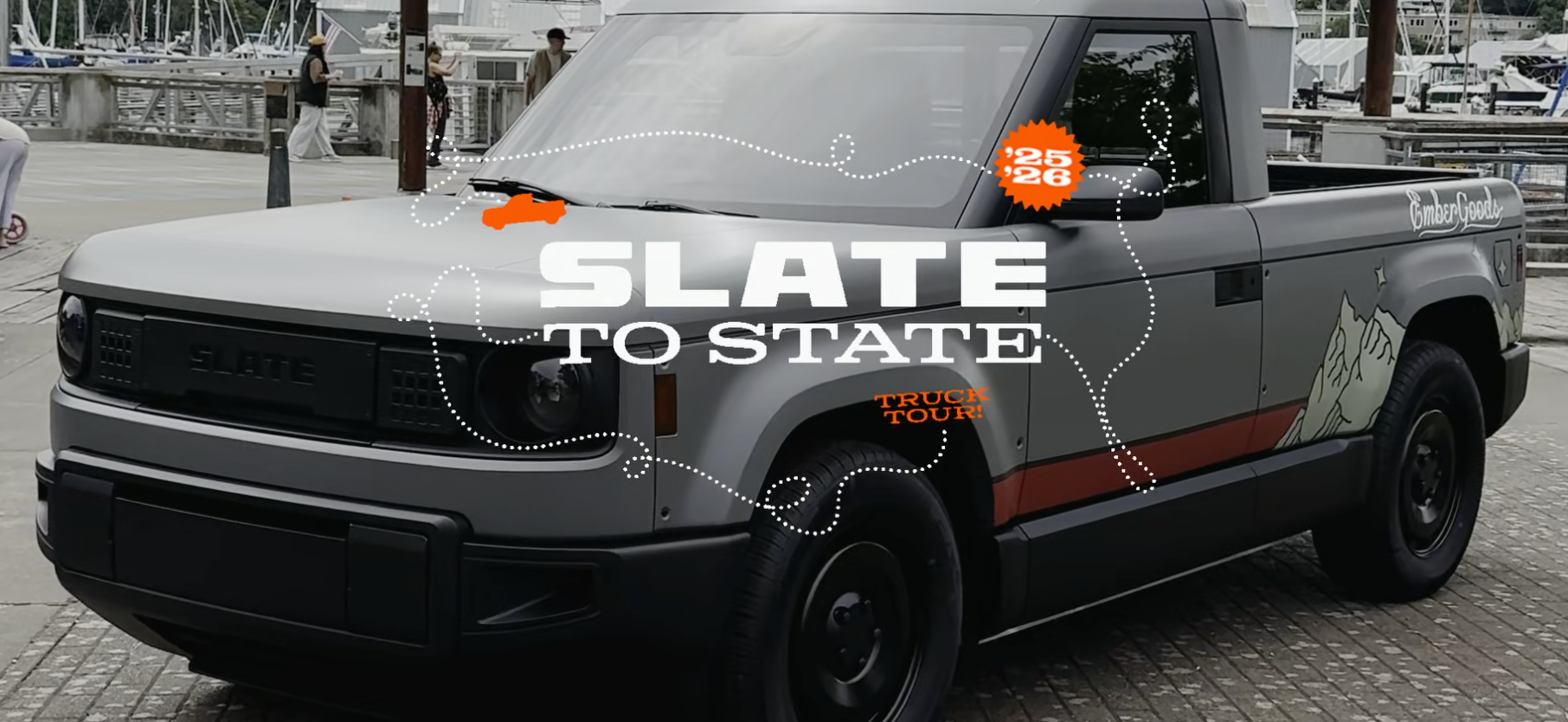
The clearest expression of this thinking was the company's public reveal. Instead of a conventional launch event, Slate parked six identical trucks across Los Angeles, each wrapped to look like a different fictional small business.
The wraps changed overnight, which meant people passing by on consecutive days started wondering whether they were looking at the same vehicle or entirely different models.
The stunt was engineered to spark conversation, and it worked precisely because it violated every expectation people have about how a car company introduces itself.
Ford is equally deliberate about how she thinks about measurement. She pushes back on the standard engagement metrics that most marketing teams optimize for, arguing that the behaviors they track are so common they barely register as genuine signals of interest.
"There's a lot of fluff and success metrics that brands go off of, like engagement, which to them could be likes and clicks and shares. But the meaning that we actually created for that person is probably really, really small, because liking something and clicking on something is such a common behavior".
- Lee Ford, Brand Strategist, Slate Auto
What she advocates instead is in-real-life brand presence: showing up in specific subcultures, working with individual creators in physical spaces, and building shared experiences that produce genuine memory. She sees this as a more durable path to brand equity than any volume of paid digital, one that creates actual community rather than an audience that disappears the moment spend drops.
How to build a community before your first delivery
Slate occupies an unusual position in the market. It is a four-year-old company that only revealed itself to the public a little over a year ago. It is still pre-delivery, without the customer reviews, reliability data, or road-tested track record that established brands lean on.
New EV entrants have a steep trust hill to climb, and buyers are understandably careful about who they believe.
Ford's answer to the trust question is a principle she returns to throughout the conversation: radical transparency. At Slate, this translates into specific and observable behaviors.
When the company doesn't have a final price to share, it tells its community when the price will be announced. When it can't answer a technical question, it acknowledges the gap and provides a timeline.
As Ford frames it, the goal is to trade the polished ambiguity common in the category for something that feels conspicuously honest.
“We try to give people a 'roadmap', Ford says. 'Hey, we don't have the final price that we can share yet, but we will be sharing it in June.' It's about giving people real information rather than smoke and mirrors. Slate held to that, revealing the $24,950 price on June 24.
The reservation model reinforces the approach. Slate's initial commitment is $50 and fully refundable, low enough to signal confidence in the product rather than desperation for cash. The company sends regular email updates to reservation holders covering factory progress, accessory details, and timelines for the Slate Maker tool on the website where customers can start visualizing their own truck.
But the most interesting outcome of this strategy is something almost nobody could anticipate.
On Reddit threads and Slate's own community forums, fans of the brand have started answering questions from skeptics and correcting misinformation without being asked. When someone posts a concern about pricing or capability, existing community members jump in with information they've gathered from Slate's own communications.
"To see that people are wanting to kind of be advocates for this brand and this type of concept has been really exciting", Ford says.
Organic advocacy this early suggests the brand's meaning has already started to compound in ways that paid media alone would never produce.
The technology has an expiration date, but your brand doesn't
When asked what advice she'd give to a marketer entering the EV or broader climate tech space, Ford's answer has nothing to do with the technology.
"Get really clear on what your value proposition is and try to stick to that, because the world moves so quickly. EVs are maybe not going to be a new technology in five years. Being clear on who your brand is and who it's for is so much more important than communicating a new technology that will no longer be new sooner than we can think".
- Lee Ford, Brand Strategist, Slate Auto
Slate operates from a set of internal beliefs that function as strategic filters for creative work:
- Simple can be stronger than complicated.
- Tech for tech's sake is overrated.
- Bigger doesn't always mean better.
These convictions determine what the brand says yes to and what it refuses, and Ford says that if she had more resources, she would invest them in larger campaigns that share this worldview with a wider audience.
The bet Slate is making is that the EV category will mature faster than most people expect. When it does, the companies that defined themselves entirely by their technology will find themselves without a story.
Slate's first trucks are still ahead of it. But the harder thing to manufacture may already be built: a brand that more than 180,000 people have reserved, and that a committed core advocates for, before anyone has sat in the driver's seat.
Summary: What mass-market climate tech can take from the Slate playbook
Slate builds trucks, not heat pumps or grid batteries, but the moves that got it to 180,000 reservations translate to almost any climate product chasing a mainstream buyer. Five are worth borrowing:
- Decide whether the category still needs educating, then act on the answer. Slate's sharpest call was refusing to teach people about EVs, because Tesla and the legacy players had already paid for that lesson. The principle is not "never educate." It is to know, honestly, whether your category's education is already done. If it is, spend your budget building equity that accrues to you, not to the category. If it is not, and much of deep tech genuinely still needs explaining, education becomes your moat rather than your tax. The mistake is defaulting to explanation out of habit when the market has already moved on.
- Make the technology the least interesting thing about you. Slate leads with affordability, ownership, and personalization, and lets "electric" sit in the background. For climate products, the equivalent is leading with the tangible payoff, lower bills, less hassle, a better daily experience, rather than the carbon math or the spec sheet. Science earns you the right to make the product. It rarely closes the sale on its own.
- Position by inversion. Slate looks at what big auto does and does the opposite, which is how a low-awareness brand punches above its budget. Any climate challenger surrounded by louder, better-funded incumbents can find its space the same way, by naming what everyone else is doing and deliberately standing on the other side of it.
- Use transparency as your trust engine before you have a track record. Most climate hardware lives in a long pre-revenue window with nothing deployed to point to, which is exactly where Slate sat. Publishing roadmaps, naming what you do not know yet, and hitting the dates you set, as Slate did with its June pricing, builds a credibility that polished ambiguity never will. Trust compounds fastest when a young company is visibly honest about being young.
- Build the community before the product. Slate's advocates were answering skeptics on Reddit before a single truck shipped. For climate tech, an engaged early community is both a trust signal and a distribution channel, and it is far cheaper to nurture now than to buy later.
The thread running through all five is Ford's parting point: the technology will stop being new sooner than anyone expects, but a clear brand and a clear sense of who it serves will outlast the novelty. For climate companies betting on mass adoption, that is the difference between shipping an early technology and building a brand that lasts.